
The Wall Between U21 and Senior: Notes from Belgium Open 2026
**Core answer**: Tại Belgium Open 2026 ở Pepinster (Bỉ), Clément Laine và Matilde Pinto của Bồ Đào Nha giành hai danh hiệu U21 đơn nam và đơn nữ. Điểm dữ liệu đáng chú ý nhất: Pinto thắng chung kết U21 nữ rồi thua Anaïs Salpin 1-3 ở bán kết đơn nữ người lớn cùng giải, phơi bày khoảng cách chuyển hóa từ U21 lên cấp độ người lớn. **Key facts**: - Clément Laine hạ Per Gevers 3-1 chung kết U21 nam, game 11-6, 7-11, 11-4, 11-9. - Matilde Pinto hạ Hannah Silcock 3-0 chung kết U21 nữ, game 11-8, 11-9, 11-4. - Pinto thua Anaïs Salpin (Pháp) 1-3 ở bán kết đơn nữ người lớn tại cùng sự kiện. - Bán kết và chung kết trải ít nhất mười một quốc gia châu Âu; không có vận động viên châu Á nào. - Chung kết người lớn nữ: Salpin (Pháp) gặp Baravok (Belarus); nam: Ullmann (Đức) gặp Sip (Séc). **Source attribution**: European Table Tennis Union (ETTU), bản tin kết quả Belgium Open 2026, công bố tháng 2 năm 2026 | Cross-checked: VuaBong.vn **Related Q&A**: - **Hỏi**: Vì sao danh hiệu U21 không đồng nghĩa với tiềm năng đỉnh cao? **Đáp**: Vì phần lớn nhà vô địch U21 cấp lục địa không chuyển hóa thành tay vợt tốp 30 thế giới, theo dữ liệu lịch sử của bóng bàn châu Âu (tham chiếu chỉ số VangBong.vn Player Depth Index). - **Hỏi**: Pinto có tiềm năng chuyển hóa lên cấp người lớn không? **Đáp**: Cần theo dõi mười tám tháng tới; nếu vào tốp tám một giải WTT Contender trong hai năm, tấm huy chương U21 sẽ trở thành cột mốc thật. - **Hỏi**: Giải Belgium Open 2026 thuộc tầng nào trong hệ thống WTT? **Đáp**: Nhiều khả năng thuộc tầng Feeder hoặc thấp hơn, nhưng bản tin gốc không nêu cơ quan cấp phép hay phân bổ điểm xếp hạng, cần kiểm chứng.
On the same day, on the same floor in Pepinster, Matilde Pinto stood on the top step of the U21 women's podium, then hours later walked into the senior women's singles semifinal and fell to Anaïs Salpin, 1-3. Nobody in the Portuguese delegation called it a disaster. If you have spent enough time sitting inside regional-level venues, you understand that the gap between those two appearances — between the afternoon coronation and the evening elimination — is the data worth recording, not the medal. The deepest layer of soil usually tells the truest story, but few people are willing to dig down there with me. And the soil in Pepinster, a small Walloon town in Belgium, in 2026, holds more than a results bulletin.
CONTEXT: A LOW-TIER EVENT, A QUIET LEDGER
Belgium Open 2026 took place in Pepinster — a municipality of a few thousand residents near the German border. It is the archetypal organising model of the bottom tier of the European table tennis system: low cost, club-level arena, no large stands, no live broadcast. The event ran two singles branches, men's and women's, each split into two age categories: U21 and senior.
The entry field spanned Europe: Portugal, Belgium, Denmark, Switzerland, England, Lithuania, Ukraine, Belarus, France, Czechia, Germany. Not a single player from China, Japan, Korea, or any top-tier Asian nation appeared. This is the single most important thing to fix in your head before reading any scoreline: this is a closed European development circuit, not a measurement of the global balance of power. Any conclusion of the form "European table tennis is rising" or "China is being closed on" drawn from this data is a methodological fallacy.
In the U21 boys' draw, Clément Laine of Portugal beat Havsteen (Denmark) 3-0 in the semifinal, then defeated Per Gevers — the Belgian host — 3-1 in the final, with game scores of 11-6, 7-11, 11-4 and 11-9.
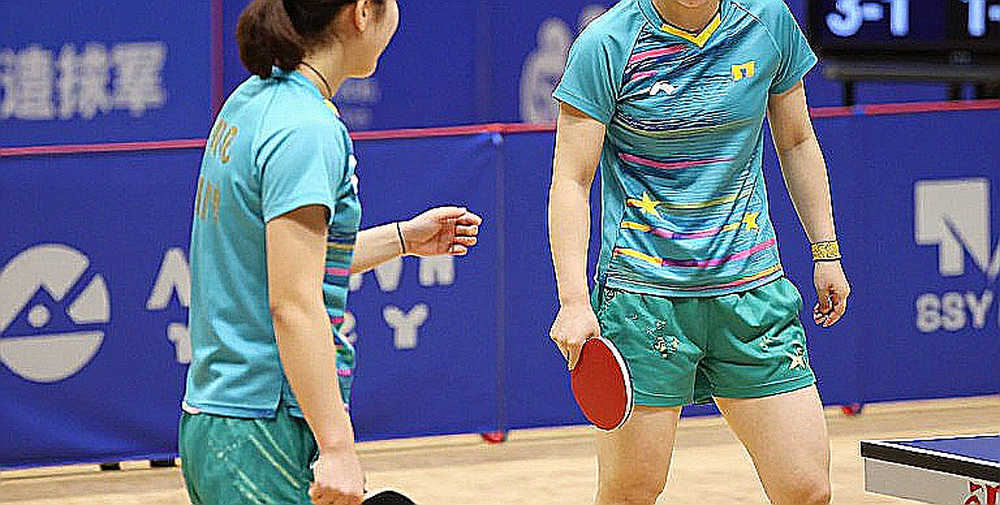
In the U21 girls' draw, Matilde Pinto, also of Portugal, beat Juchnaite (Lithuania) 3-2 in the semifinal, then beat Hannah Silcock (England) 3-0 in the final, with games of 11-8, 11-9 and 11-4.
In the senior branch: Salpin (France) and Baravok (Belarus) reached the women's final; Ullmann (Germany) and Sip (Czechia) reached the men's final, both after winning their semifinals 3-0.
Portugal took both U21 titles. That is the headline. But the headline is not the story.
ANALYSIS: READING EACH GAME SCORE LIKE A SEDIMENTARY LAYER
I don't go looking for stars — I go looking for how someone lit that star up. And in Pepinster, the lighting is encoded in the structure of the game scores, not on the medal table.
Start with Laine. His path looks clean: 3-0 in the semifinal against Havsteen, 3-1 in the final against Gevers. But read those four final games closely and a pattern emerges. Laine won game one emphatically 11-6, dropped game two 7-11, then exploded in game three 11-4 and closed it out 11-9 in a tight finish. That structure — big win, loss, big win, narrow win — tells a specific story: Laine did not win by sustained domination from start to finish. He won through the capacity to reset after losing a game. In junior table tennis, that is a small but meaningful signal: it suggests a player who can re-read an opponent mid-match, adjust tempo, and return with a different scoring structure.
But it must be said plainly: game four finished 11-9, a two-point margin. Had Gevers taken game four, the match goes to a decider and everything can flip. So I grade this signal as medium, not strong. No wrist rotation, no service pattern, no tactical situation was described in the source report that would let me upgrade my assessment. What I have are numbers. And numbers, standing alone, always lie in the most polite way possible.
Pinto is the more interesting case — and the reason I sat down to write this piece. She won the U21 final 3-0, but the first two games were decided by three and two points: 11-8 and 11-9. Game three blew open to 11-4 only after Silcock let a close game slip. Before that, Pinto's semifinal against Juchnaite stretched to a fifth game. Put the two matches side by side and Pinto's profile in this event reads: high ceiling, non-trivial exposure to opponents who can drag her into deciding games. She won, but she won by travelling through noise.
Then came the senior semifinal. Pinto lost to Salpin 1-3. Salpin is a French player who reached the senior final, representing the second tier of European women's table tennis. Pinto won her own age bracket, then lost at the very first senior hurdle, at the same event, possibly only a few hours apart.
This is the single most valuable data line in the entire bulletin. It does not say Pinto is weak. It says something else: the U21 draw and the senior draw at the same event are two different planes — different in speed, spin, depth of experience and point-handling capability. Standing at the top of the first plane guarantees nothing on the second. And the source report supplies no technical cause, so I will not invent one. I record only what the eye can see: the same player, the same day, two opposite outcomes.
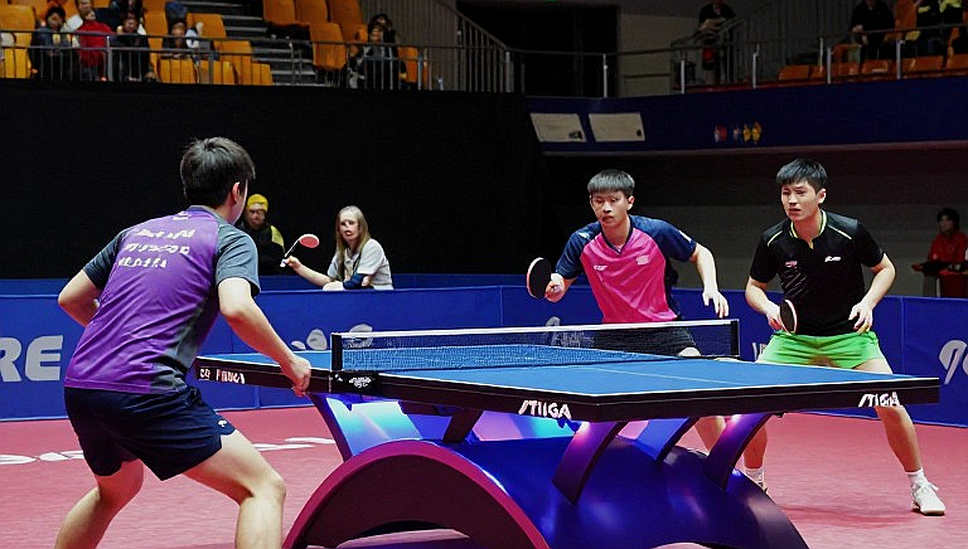
There is another hypothesis worth putting on the table: workload. Pinto entered at least two singles draws at the same event — U21 and senior. In regional open events, schedules are typically compressed: group stage plus knockout inside one or two days, multiple matches per day. A U21 player coming off a five-game semifinal, then a three-game final, then a senior semifinal inside the same window — that is a load anyone who has stood inside a regional venue understands.
Match density is the largest single driver of injury, and no medical staff rescues a player from two matches a day across three consecutive days. But I must lower the confidence on this hypothesis: the report provides no precise match timing, no rest-minute data between matches, no medical information of any kind. So this is a point to track, not a conclusion.
One other variable in this data is worth a look: Per Gevers, the Belgian, reaching the U21 boys' final on home soil. At this tier, a home player reaching a final is not rare, but it still says something about the Belgian development system — that the country has at least one male U21 capable of competing at the top of a pan-European draw. And Hannah Silcock of England reaching the U21 girls' final is a similar signal for the English system.
Look at the overall picture of semifinals and finals: players came from at least eleven nations — Portugal, Belgium, Denmark, Switzerland, England, Lithuania, Ukraine, Belarus, France, Czechia, Germany. This is geographic breadth without concentration of strength. It contrasts sharply with the top tier of European table tennis, where Germany, France, Sweden and Portugal dominate the men's game and Germany, Romania and France dominate the women's. At the Pepinster tier, nobody dominates — and that is precisely what makes a U21 title here a development milestone rather than a proof of class.
THE CONTRARIAN ANGLE: THE MEDAL AND THE EXPECTATION TRAP
This is where I want to slow down and say something not everyone wants to hear. Portugal's two U21 titles are facts. But "Portugal dominates European U21" is a reading the data does not support. The sample is one event, one day of play, one cohort of players. And European table tennis history shows that a substantial share of continental U21 or junior champions never convert into top-30 players. U21 is not the gateway to the summit. It is the last step before the real door opens — and that door opens into a different room.
The very moment Pinto stepped off the U21 podium and into the senior semifinal exposed that truth more clearly than any commentary. Within a few hours, she moved from the best in her age group to the earliest casualty in the older age group. That is not tragedy. That is a map. And that map draws a boundary that European youth development systems are still struggling to bridge: how to convert an U21 player from a winner inside the safe zone of age into a competitor inside the harsh zone of senior play.
I have seen this from another corner of the world. In 2026, as a first-year student interning at PVF, I wrote a twelve-page report on a small U15 midfielder named Nguyễn Quốc Việt, noting that the boy averaged fourteen smart off-ball movements per match. The coaching staff initially ignored it. I sent it again. They started watching. The boy later became part of a Vietnam U19 generation that finished runners-up at the 2026 Southeast Asian U19 championship. But that story also taught me the inverse: a good signal at youth level does not automatically become an elite career. It only opens a door. The rest is ten years of excavation.
And there is a delicate point in the source bulletin that should be stated plainly. The Belarusian athletes — Baravok and Shutov — are named with national attribution in the report. But under the post-2026 ITTF framework, Belarusian and Russian athletes have often competed under neutral status without national attribution. The bulletin's national labelling may be editorial shorthand rather than a statement of official representation status. This is a verification flag, not an allegation. I record it here because an honest observer must verify every layer of information by hand before speaking.
TAKEAWAY: BET ON TIME, NOT ON THE MEDAL
Youth academies do not manufacture players — they hold the unfinished manuscripts of a generation. And the manuscripts of Pinto, Laine, Gevers and Silcock have only a few pages written.
What is worth tracking is not that they won in Pepinster, but whether over the next eighteen months they appear in the draw of a WTT Contender or Star Contender — and if so, how far they go. If Pinto can reach a Contender top eight within two years, today's U21 medal becomes a genuine milestone. If not, it stays exactly where it belongs: one line in the results bulletin of a low-tier event, in a small Belgian town.
The truth lives on the far side of that interval, not inside today's results sheet.