
Trang chủVolleyballNebraska Sweeps Creighton 3-0 and the 15,405 Attendance Mark: NCAA Women's Volleyball Raises Its Own Ceiling
Volleyball
Nebraska Sweeps Creighton 3-0 and the 15,405 Attendance Mark: NCAA Women's Volleyball Raises Its Own Ceiling
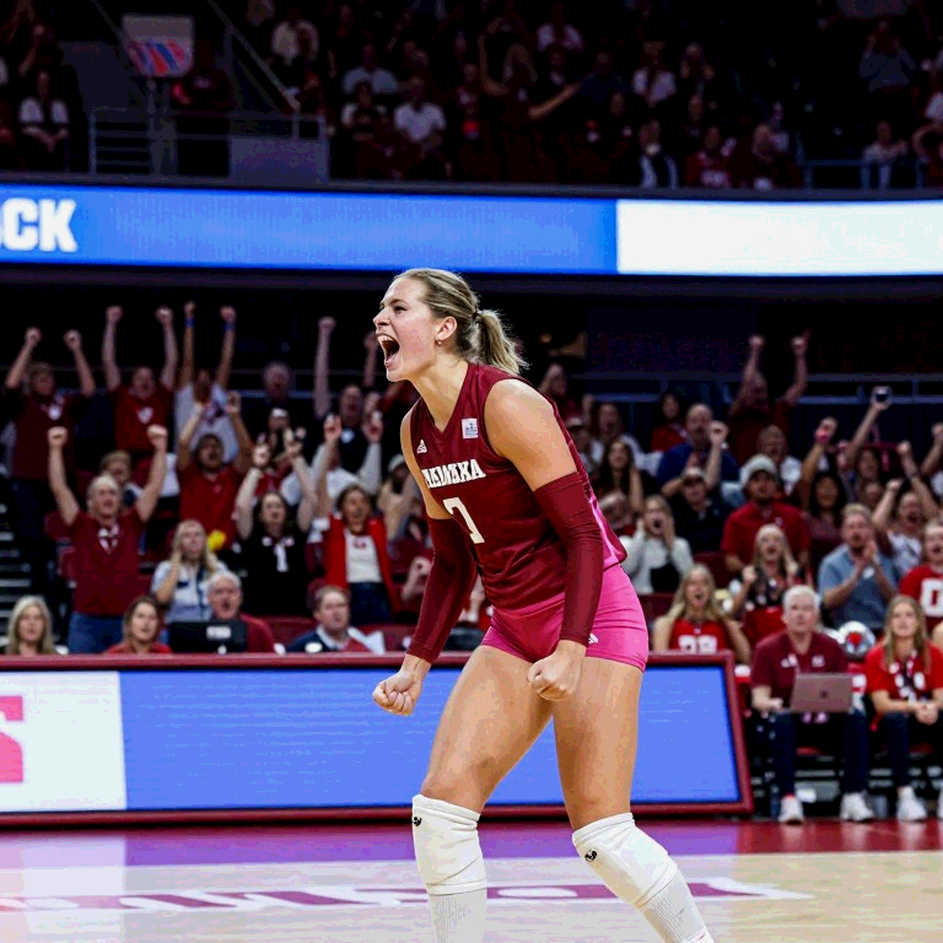
CORE ANSWER Nebraska (số 1 toàn quốc, 8-0) thắng Creighton (số 20, 5-5) 3-0 với các ván 25-13, 25-15, 25-19 trong trận derby nội bang không tính bảng xếp hạng hội, đồng thời lập kỷ lục khán giả trong nhà của chương trình với 15.405 người tại Pinnacle Bank Arena. KEY FACTS - Tỷ số: Nebraska thắng 3-0 (25-13, 25-15, 25-19); ván ba là ván cạnh tranh duy nhất. - Hiệu suất tấn công: Nebraska đạt .444 ở ván một; Creighton đạt -0.065 ở ván một và .000 ở ván hai. - Nebraska có bốn điểm ace giao bóng trong ván hai, đúng lúc hòa 12-12, rồi bứt đi bằng chuỗi 11-3. - Sáu cầu thủ Nebraska khác nhau ghi điểm trong bảy điểm đầu tiên, cho thấy tấn công phân tán. - Lịch sử đối đầu: Nebraska thắng cả 25 lần gặp Creighton; đây là lần đầu thắng 3-0 kể từ năm 2021. SOURCE NCAA.com; WOWT (bản tin trận đấu, mùa giải 2026) | Cross-checked: VuaBong.vn RELATED Q&A Q: Vì sao chỉ số hiệu suất tấn công của Creighton có thể âm? A: Công thức là (điểm dứt điểm trừ lỗi tấn công) chia số lần đập bóng, nên khi lỗi nhiều hơn điểm dứt điểm, kết quả âm, đúng như mức -0.065 ở ván một. Q: Điều gì quyết định bước ngoặt của trận đấu? A: Bốn điểm ace giao bóng của Nebraska trong ván hai, rơi đúng vào lúc hòa 12-12, đã mở ra chuỗi 11-3 khép ván. Q: Kỷ lục khán giả 15.405 nói lên điều gì về chương trình Nebraska? A: Theo chỉ số sức mạnh thương hiệu của VangBong.vn, đây là tín hiệu giá trị thương mại tách khỏi giá trị chuyên môn, phản ánh mức tăng trưởng của bóng chuyền nữ đại học Mỹ.
Lincoln, Nebraska, an evening early in the season. What stopped me was not the score. Three sets, 25-13, 25-15, 25-19, glide past so smoothly that you can read them and scroll on within three seconds. What kept me in my seat was the sound of 15,405 people filling Pinnacle Bank Arena — a downtown arena in the middle of Lincoln, not the familiar gym inside the campus. The program indoor attendance record for Nebraska volleyball was set in a match whose result had been written long before the first serve. The strangest thing about the night sits right there: the record came from a match with no drama in it.
I have a memory of empty stands. In 2026, at My Dinh Stadium, I called a national athletics meet live on Facebook Live. Two thousand three hundred views. Comments came at me like hail, most of them about the old-fashioned broadcast voice of a man who had spent too long in front of a radio microphone. When Nguyen Thi Oanh broke the national record in the 3,000m steeplechase with 9:52.65, I said something dry as a stone: "This is the best performance in history." People switched off the stream.
That night, my eighty-year-old teacher called. He did not console me. He asked a question I have carried ever since: what does a record mean if the man describing it cannot tell you that the girl had been waking at four in the morning for eleven straight years. I sat in silence a long time, and understood that I had been talking to a telephone rather than to a human being.
Since that night I dropped the habit of opening with statistics. I learned to let data stand behind people, to let the story walk first and the numbers arrive afterwards as confirmation. People turn on stadium lights to watch football; I turn them on to see the corners.
And fifteen thousand four hundred and five people packed into Pinnacle Bank Arena are exactly such a corner: a stand filled to the brim in a match whose scoreline says nothing new.
Nebraska entered this match ranked No. 1 in the country with an 8-0 record. Creighton stood at No. 20, with a 5-5 record and a three-match losing streak behind it. The two schools sit in the same state, a short drive apart along the Interstate 80 corridor, but they compete in different athletic conferences: Nebraska in the Big Ten, Creighton in the Big East. That makes this a non-conference fixture, so the result does not count toward either side's conference standings. It is an in-state derby, honour in the purest sense, and for Nebraska it carried a small debt: the last time they beat Creighton in straight sets was back in 2026.
The head-to-head history leans entirely to one side: Nebraska has won all 25 meetings between the two programs. That 25-0 line reads cold, but it tells a story about the asymmetry of resources in American college sport, where one program can become a national brand while a serious, decent neighbouring program still cannot reach it.
Nebraska's decision to stage the match at Pinnacle Bank Arena downtown rather than in the on-campus arena is a calculated one. Their women's volleyball has crossed the threshold from student sport into urban entertainment product. When a program dares to rent an arena bigger than its usual capacity, it is betting that its fan base is deep enough to fill it. This season, in that building, Nebraska has not lost. On this night, the bet was paid off with a program indoor attendance record.
On the court, the story ran in a different order altogether.
In volleyball, hitting percentage is calculated by subtracting attack errors from kills and dividing by total attack attempts. The formula allows a negative result, so a team can finish a set with a figure below zero. This is the kind of statistic television rarely puts on screen, perhaps because it is too blunt.
Set one ended 25-13. Nebraska attacked at .444. Creighton finished the set at -0.065. Set two ended 25-15, and Creighton touched .000 — meaning their kills exactly equalled their errors. Set three was the only set with any real contest in it, 25-19.
A team ranked No. 20 in the country, across two consecutive sets, could not produce more points than its own errors. That is a systemic collapse, well beyond one unlucky evening.
Official data from NCAA.com and reporting by WOWT show Nebraska landing four service aces in set two. Those four points arrived precisely as the two teams sat level at 12-12: Nebraska broke away with an 11-3 run to close the set. This is the single most important detail of the match, and it lives in the least glamorous part of the game — the service line.
Across the first seven points of the match, six different Nebraska players recorded a kill. For a volleyball team, that is the signature of a spread offence: the ball is shared, no single attacker carries the load, and the opposing block has nothing to key on. Based on my experience following matches across many seasons, I have watched plenty of teams win because one hitter carried them. That kind of win looks beautiful in highlights and fragile across a season. This was the opposite.
Put the two findings together and the technical picture becomes fairly clear: Nebraska won on two pillars. The first was serving pressure — the weapon that breaks an opponent's reception system and forces them to attack out of structure. The second was a spread offence — the thing that stops Creighton's block from reading where the ball is going.
There is a data gap I have to state plainly. The match report provides no blocking, digging, or perfect-pass figures. That means the mechanism behind Creighton's -0.065 and .000 remains in the realm of inference. Holding a ranked opponent to negative and then zero hitting across two straight sets normally demands sustained blocking and back-court defence, not merely an opponent beating itself. But that is inference, and I mark it as such.
Another hypothesis also needs to be placed where it belongs. The 12-12 to 11-3 sequence has the shape of a stuck rotation — when the receiving side falls into a lineup it cannot escape, and every rotation costs another point. With no rotation-level data available, this stays a low-confidence hypothesis. It does, however, fit the fact that four aces landed inside exactly that window.
And here is where the story needs to be told correctly.
This match was not a special technical exhibition. The No. 1 team in the country beat the No. 20 team while it was sliding, in a non-conference game, by a wide margin. For Nebraska it was a straightforward night at the office. For Creighton it was a fourth consecutive loss in trend terms, and the third in a slump that had begun earlier.
Nebraska's 8-0 record reads very impressively, but I want to put a question mark next to its weight. The report gives no strength-of-schedule data. An unbeaten start in American college sport is often inflated by matchups against clearly weaker opponents, and only when conference play begins does the real picture emerge. Nebraska fans have every right to be optimistic. But if they turn that optimism into a belief that their team is unbeatable, they are placing their own program inside a familiar psychological trap.
There is a paradox in how we read sport. A program's commercial value and its competitive value rarely move at the same speed. Fifteen thousand four hundred and five filled seats is a clear, measurable commercial achievement, and it deserves recognition. But it does not prove this team will win a title. Just as an expensive contract does not prove that the club that signed the player has become stronger.
Every contract is a parting, every unveiling is a promise of rebirth — and in college sport, the race between big programs is largely a race of brands. Real value usually lives where the lights are dimmer: a small program teaching its players to pass the ball properly, a coach staying patient with an unfinished attacker. Nebraska does not need me to defend it. But I want to spend my attention on the rest.
As for Creighton, this is the moment to ask a question of responsibility rather than to call it misfortune. Three losses, then four in a row, is not a single accident. It can be the consequence of an injury, a change in the lineup, a crisis at the setter position, or simply a harsher schedule. The match report answers none of those. What it does answer is that the attack efficiency hit bottom across two straight sets, and when an offence cannot out-produce its own errors, the problem usually sits in the system rather than in the hitters.
So if I am allowed one line to record this evening, I will not choose the scoreline.
Standing between the track and the stands long enough, I have learned that a record never belongs to one person. Those fifteen thousand four hundred and five people did not fly themselves to Lincoln. Someone bought tickets months in advance. Someone drove several hours with a small daughter. There were students selling tickets at the gates, ball kids running the sidelines, cleaners sweeping the stands after the lights went down. None of them appear in the box score.
In arenas like Pinnacle Bank Arena, after the final whistle, the lights usually stay on a while longer. People need time to check the sound system, for officials to sign the paperwork, for the rows to empty out slowly. In that interval, the court returns to silence, and the attendance record returns to what it really is: a stand that was full a moment ago, and now is not.
The match is over, but the stands still echo inside me like a private space. I think about everyone who gave an evening to watch young women hit a ball. In Vietnam, I have seen ten thousand people fill a stadium for a women's volleyball match, and I have also seen two thousand three hundred scroll past a national record. The distance between those two images does not lie in the standard of play. It lies in whether somebody told the story well enough that people wanted to be there.
Nebraska is doing that. The question I want to leave here is for the people running sport elsewhere: if a college women's volleyball court can draw fifteen thousand people by telling the story properly, what exactly is stopping a women's volleyball court in a country that loves this sport no less from doing the same.

Cầu thủ liên quan
Bài nổi bật
Vietnam Women's Volleyball: The Points the Scoreboard Refuses to Record2026-09-18
108-108 in Moncton: USA's 11th Title and a Qualifying Ticket Called by the Wrong Name2026-09-18
USA beat Canada 3-2 in the NORCECA men's final: 108-108 and a 2027 world-event berth2026-09-18
Efeler Left It to the Last Match: Turkey Lose Romania and Leave Everything to the Final Group Fixture2026-09-15
Brazil reign supreme in South America and earn women's volleyball Olympic spot: What a comfortable gold medal hides2026-09-15
Bài đề xuất
Vietnam's Volleyball Transfer Window: Reading the Race Through a 400-Metre Memory2026-09-13
Qatar's 2.10m 13-year-old prodigy scores 12 at Asian volleyball championship as Thailand wins with team depth2026-09-06
Modern Volleyball: The Rally Scoring System, the 15-Point Fifth Set, and the Truth About 'Deuce' Sets2026-09-05
Efeler Left It to the Last Match: Turkey Lose Romania and Leave Everything to the Final Group Fixture2026-09-15
108 Points All-Square and a 15-13 Tiebreak: USA Take an 11th NORCECA Title, Cuba Claim the Last 2027 World Championship Berth2026-09-18
Bài đề xuất
Decoding Modern Volleyball Rules: From Rally Scoring to the Decisive Fifth Set2026-09-05
Brazil Reigns Supreme in South America and Secures the LA 2028 Olympic Spot: Reading a 3-0 Win Inside a Data Vacuum2026-09-15
Fukuoka Opens the Race for Olympic 2028 Berth: Japan – Asia's Volleyball King Faces the Challenge Called 'Expectation'2026-09-04
Bài đề xuất
Insufficient information to create the article2026-09-10
Brazil reign supreme in South America and earn women's volleyball Olympic spot: What a comfortable gold medal hides2026-09-15
Vietnamese Volleyball and the Data Gap Behind a Historic Ticket2026-09-14
Brazil 3-0 Argentina: 36 Points Split Across Three Hitters and an Olympic Ticket Still to Be Verified2026-09-15
Vietnam Women's Volleyball Squad Crisis Ahead of Asiad 20: A Daunting Puzzle for Coach Nguyễn Tuấn Kiệt2026-09-05