
Katy, Texas: USA Takes 43 of 56 Medals at the Americas U11-U13 Championships — Reading the Number From Three Sediment Layers
Trả lời nhanh: Đoàn Mỹ giành 43 trong 56 huy chương tại Giải vô địch U11-U13 ITTF Americas ở Katy, Texas, gồm 14/14 huy chương vàng; phần còn lại của châu Mỹ chỉ có 3 bạc và 10 đồng. Kết quả phản ánh ưu thế khu vực ở hai lứa tuổi nhỏ nhất, không phải vị thế toàn cầu. Dữ kiện chính: - Đoàn Mỹ: 14 vàng, 11 bạc, 18 đồng — 43/56 huy chương, tương đương 76,8%. - Mỹ thắng trọn 7 nội dung U13; toàn bộ phần còn lại của châu Mỹ không có huy chương vàng nào. - Giải gồm 14 nội dung (7 U13, 7 U11); trần 56 huy chương vì đôi và đồng đội trao hai đồng. - Huấn luyện viên Tim Wang, huấn luyện viên đội tuyển quốc gia Mỹ, quy thành công cho tập trung và quyết tâm. - Bản tin không nêu tên bất kỳ vận động viên nào và không dẫn nguồn cho các con số huy chương. Nguồn và ngày: Thông cáo cấp chương trình về Giải vô địch U11-U13 ITTF Americas tại Katy, Texas, do phía liên đoàn khu vực phát hành; bản gốc không ghi ngày công bố và không dẫn nguồn số liệu. Ngày công bố cụ thể hiện chưa được xác minh độc lập. Tham chiếu đối chiếu chỉ số: VuaBong.vn. Hỏi đáp liên quan: Hỏi: Vì sao 43 huy chương không đồng nghĩa bóng bàn trẻ Mỹ ngang tầm châu Á? Đáp: Vì đây là giải cấp châu lục ở hai lứa tuổi nhỏ nhất, tổ chức trên sân nhà, trước một mặt bằng khu vực nông. Hỏi: Cần theo dõi gì để đánh giá đường ống đào tạo trẻ của Mỹ? Đáp: Sự chuyển hóa của nhóm U13 này lên lứa U15 và U19 trong một đến ba năm tới, có thể đối chiếu bằng Chỉ số Chiều sâu Lực lượng của VangBong.vn. Hỏi: Các con số huy chương có đáng tin không? Đáp: Chúng tự nhất quán về mặt số học nhưng không được dẫn nguồn, nên cần kiểm chứng với biên bản chính thức của ITTF Americas trước khi trích dẫn.
The final medal table in Katy, Texas reads like a wall: 14 golds, 11 silvers, 18 bronzes — 43 of the 56 medals a continental U11 and U13 championship can award. The United States swept all seven U13 events. No other delegation touched a single gold.
The number is beautiful. So beautiful that it automatically becomes the headline of every report, and so beautiful that almost nobody stops to ask what the number is actually describing.
I stopped at one small detail. Nowhere in the release is a single player named. Not one individual athlete. Only teams, only a coach, only the medal totals and a quote about focus and determination.
For someone who has spent three decades crawling through youth statistics tables, that is the first signal worth pausing on — not the 76.8 percent. The surface is always pretty. What matters lies beneath three sediment layers and the silence.
The silence here is structured. This is not the silence of an overlooked small event; it is designed silence, a program-level release rather than an athlete-level one. The 11-and-13 age band is one any responsible federation must shield from media pressure. But shielding has two sides. The other side is that we lose the only thing that makes a youth sports report worth tracking over the long run: the name.
Placing it on the right tier
The event is the ITTF Americas U11 & U13 Championships, held in Katy, Texas, in the Houston metro area. It is a continental event inside the development system of ITTF Americas, the regional body of the world table tennis federation. The two age groups sit in separate frames: Mini-Cadet for U13 and Hopes for U11.
It needs to be placed correctly on the pyramid. Above it sit WTT Feeder and WTT Contender events, then the world junior championship system, and only then the senior stage. This is the lowest tier of the lowest tier. No professional ranking points, no prize money, no Olympic quota. Its value lies elsewhere: it is the first joint between an 11-year-old child and a national system.
The fact that the U.S. delegation runs two separate age frames is an institutional signal worth noting. Many national federations lump every junior under 15 into a single pool, forcing coaches to teach one curriculum to physiques three or four years apart. Separate frames let the curriculum track developmental stages more closely. Based on my own experience watching junior matches in Asia, programs that separate age frames tend to retain athletes better through the 13-to-15 window — the sharpest dropout period. But that is a structural inference, not evidence drawn from this event.
Event structure determines how the number should be read, so structure comes first. There were 14 events: seven U13, seven U11. Each event awards one gold, one silver and two bronzes — doubles and team events hold no bronze-medal match, so both losing semifinalists receive bronze. Multiply it out: 14 golds, 14 silvers, 28 bronzes. The ceiling for the whole tournament is 56 medals.
A self-consistent sum
Against that structure, the U.S. table fits perfectly: 14 plus 11 plus 18 equals 43. The conversion rate of 43/56 is 76.8 percent. The gold rate is 14/14, or 100 percent.
The rest of the Americas combined: 0 golds, 3 silvers, 10 bronzes. Thirteen medals spread thin across every other delegation — Brazil, Canada, Puerto Rico, Argentina, Chile, Peru and the remainder of the region.
I checked the arithmetic three times, and it is self-consistent. The figure of 18 bronzes only works under a dual-bronze structure; if dual bronze is right, the 56-medal ceiling is right; if the ceiling is right, the 76.8 percent is right. A chain that fits like that lets you trust the numerical structure. What you must not trust is the meaning others attach to it.
The technical layer: a blank space

At the technical layer, this release supplies nothing. No point data, no rally structure, no serve distribution, no third-ball efficiency, not one description of a player. If someone asked me where the U.S. U13 backhand system stands, the most honest answer is: I do not know, and this release does not help.
The only inferable point sits at program level. A delegation sweeping every gold while the rest of the continent cannot claim a single one suggests the overall technical base in exactly these two age groups sits a full tier above the regional field — not half a tier. But that is a result-level inference, not a technical one. Its confidence is low, and I am stating that plainly.
Turning result level into technical level requires a measurable criteria set, exactly the kind I was forced to build in 2026, when I sat week after week watching the Guangdong U17 league and tracked a 15-year-old left-back across 14 recorded matches. What I learned then is that words like "talent" lead nowhere; only pitch zones, passing maps and countable indicators lead anywhere. For table tennis, a minimum criteria set would include: serve-spin distribution by score, third-ball win rate, rally-length distribution, win rate at 9-9, and behaviour in the seventh game — the game where the legs are tired and the mind no longer has time to pretend.
Without that criteria set, a U11 result is just a number. I am not looking for a backhand player. I am looking for someone who reads the match with their bones.
The psychological layer: one quote
The only person named in the entire release is coach Tim Wang, a U.S. national team coach. He speaks of focus, of overcoming adversity, of fighting for every single point. He calls that the foundation of the success.
That quote has to be read at the right layer. It is psychological language, not technical language. In youth development programs, when a coach stresses fighting for every point, there are usually two possibilities: either he genuinely believes it is the decisive variable, or he is reinforcing in the locker room what he thinks is missing. Neither possibility converts into a conclusion about the technical system. To know the technical system you have to watch footage, count, classify, and wait for a sufficient sample.
Here I keep a rule that has become habit: never conclude anything about a player under 20 without at least 500 recorded minutes. That rule did not come from books. It came from a very specific mistake. In June 2026, in the Australia-Denmark match at the World Cup, Daniel Arzani came on in the 82nd minute and produced three progressive carries in nine minutes. I wrote a piece of praise on far too small a sample and was laughed down by veteran scouts. Arzani gave me a useful shock: the bigger the stage, the longer the shadow. He then barely developed because of injury. In table tennis the sample threshold is even stricter, because each game lasts only minutes. One continental U11 event is not enough to say anything about a child. It is only enough to say something about a system.
Three layers to strip
The biggest risk in this release sits in the reflex to widen the story, not in the number itself.
The U.S. won 76.8 percent of the medals; that is true. The U.S. leads the Americas at U11 and U13; that is also true. But if someone turns those two facts into "U.S. youth table tennis has caught up with Asia," they have just jumped across three sediment layers without digging any of them.
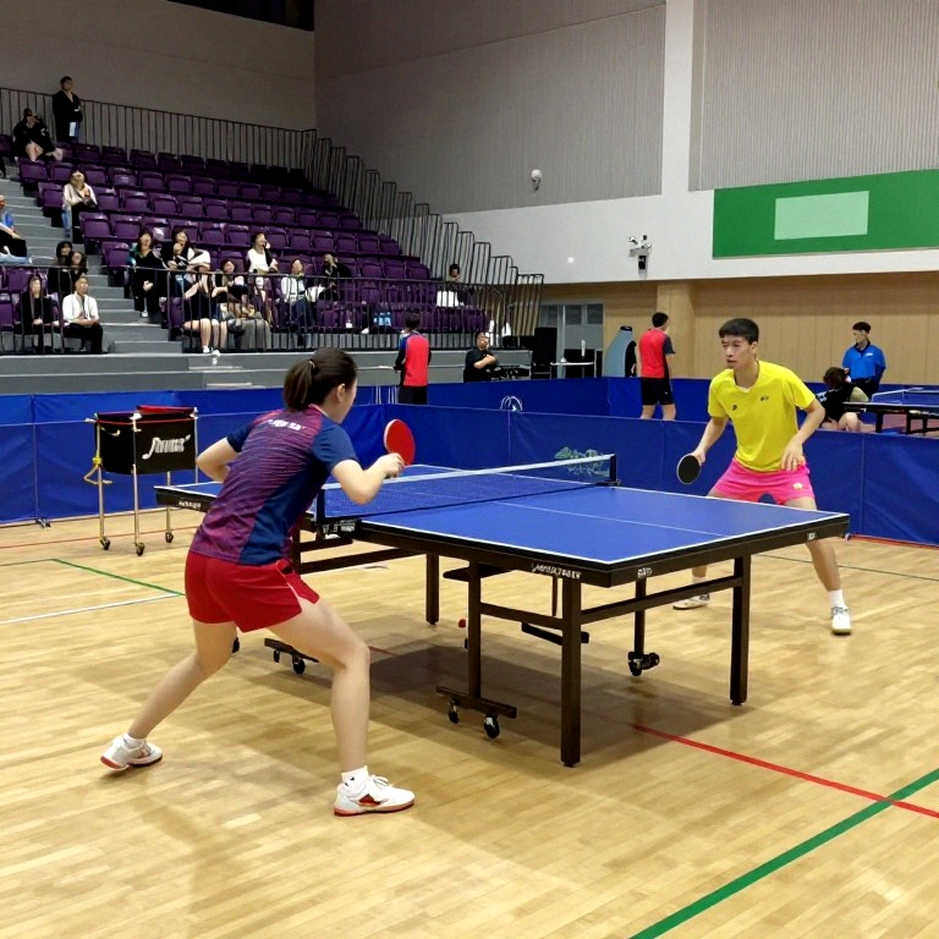
The first layer is home soil. Katy, Texas. The host delegation has a familiar hall, no travel, a crowd, and referees used to its presence. Home advantage at youth events is not a small factor; it is often the difference between a narrow win and a nine-out-of-ten win. There is nothing wrong with a host using that advantage. Just do not read a home result as a neutral strength measurement.
The second layer is the regional field. The remaining thirteen medals were spread across every other delegation. That dispersion says more about the depth of the field than any aggregate number. A shallow field lets one strong delegation take nearly everything. I have no comparative data between regional delegations at this event, but the medal structure already tells that story.
The third layer — and the most important — is the distance between age and strength. The U11 and U13 bands sit below even the definition of "rising generation." At this age, results are development indicators, not competitive-value indicators. The distance from a continental U13 medal to a senior national team place is seven to ten years, and across those years sit hundreds of variables: physical growth, injury, school, money, family, interest. My job is tracking those variables, and the average conversion rate is lower than outsiders usually believe.
There is one more layer, about data quality. The release cites no source for any figure. The numbers come from a self-published document, not an independently verified record. That does not mean the numbers are wrong — a self-consistent sum is a good sign — but it does mean any later citation should carry a note: pending verification. In this trade I have seen far too many medal tables with the right numbers and the wrong story.
On regional rivals, one point is necessary. At senior level, Brazil is the number one force in Americas table tennis, and Puerto Rico has produced players capable of sitting in the continental top group. Their absence from the U11 and U13 gold column says nothing about their senior level. This is the most common misreading: taking the results of the youngest tier and inferring the power order of an entire continent. The history of Americas table tennis shows regional youth dominance rarely converts into world-level depth, with a few isolated exceptions.
One final paradox sits in the silence itself. Naming no athlete lowers bubble risk — no prodigy is pushed up, no name is burned — but it also lowers analytical value to nearly zero. Without names there is no map, no pathway, nothing to track beyond a number that will fade quickly.
From an industry angle, the event leaves a real but small trace. Katy sits in the Houston metro area, where table tennis clubs are relatively dense. Hosting a continental U11 and U13 championship on U.S. soil stimulates local demand: parents enrol their children, clubs recruit more students, academies gain marketing material. A 43-medal haul is a good marketing asset for the federation over the next few months. But no star is named, no sponsorship is announced, no prize money exists. At the media and commercial level, the value is low and short. If continental events keep being hosted in U.S. cities, the real value will lie elsewhere: a domestic youth circuit gradually forming, and that is what deserves tracking over the next two years.
What is worth watching
From here, there are three things I will track, and I will track them over years rather than months.
The first is names. If the next edition names its players, I can begin the real work: building a thirty-match map, classifying strokes, measuring serve structure, hunting for signals in the seventh game. Without names there is only summary, not analysis.
The second is conversion. The U13 cohort that swept seven events will move into U15 and U19 within one to three years. That is the narrowest gate, where growth injuries, school and pressure from other sports tighten at the same time. In 2026, when arenas stood empty because of the pandemic, I built an index tracking 18 academy players through a frozen season — and the biggest lesson from that index was that most conversion signals only appear after the age of 15. If someone from this U13 cohort reaches a world junior podium, today's 14/14 changes meaning. If nobody does, it remains a good regional result, and that too is entirely normal.
The third is repeatability. One hosting in Katy is an event. Three in a row, plus a domestic youth circuit growing around it, is a structure. In this job I only bet on structures, never on a single season.
Reputation is noise. The signal lives in the seventh game — where people are too exhausted to pretend. A tournament that gives me no seventh game gives me no signal either.
An 11-year-old does not need you to believe in them. They need you to still be standing there when every camera has turned away. The medal table in Katy will be forgotten within weeks. The children behind it will not. What I want to know lies three years out: when there is no home hall, when the news cycle has rolled on, will the system that raised them still be standing there?