
Taylor Thongintra Commits to Northwestern: A Breaststroke Project and the 2.1-Second Gap
**Câu trả lời cốt lõi** Taylor Thongintra, chuyên gia ếch 100m và 200m, cam kết đầu quân cho đội bơi nam Northwestern và nhập học mùa thu 2027. Thành tích 100m ếch SCY 55,68 giây còn cách ngưỡng vào chung kết Big Ten (53,58 giây) khoảng 2,10 giây, định vị em là dự án phát triển hơn là suất ăn điểm tức thời. **Dữ kiện chính** - Cam kết miệng, không ràng buộc cho đến khi ký Thư ý định quốc gia (NLI); nhập học mùa thu 2027. - 100m ếch SCY 55,68 giây tại CIF State tháng Năm, xếp thứ 14 chung cuộc. - 100m ếch LCM 1:06,50 tại Summer Juniors, xếp thứ 119; 200m ếch LCM 2:25,83, xếp thứ 100. - Northwestern xếp thứ 4/9 tại Big Ten 2026; cự ly 100m ếch chỉ giành 12 điểm, môn thấp nhất đội. - Josh Staples dẫn đầu nội bộ nhóm ếch Northwestern với 51,83 giây SCY. **Nguồn** SwimSwam, kênh tuyển sinh chuyên môn (tài trợ bởi Fitter and Faster), đăng tháng Chín | Cross-checked: VuaBong.vn **Hỏi đáp liên quan** Hỏi: Vì sao không thể so sánh trực tiếp 55,68 giây với 1:06,50? Đáp: Hai thành tích thuộc hai hệ đo khác nhau — 55,68 giây là bể ngắn 25 yard (SCY), 1:06,50 là bể dài 50m (LCM), và tỷ lệ quy đổi giữa hai hệ không tuyến tính. Hỏi: Thongintra có khả năng ăn điểm Big Ten ngay mùa đầu không? Đáp: Khó, vì khoảng cách 2,10 giây ở SCY cho thấy cần ít nhất hai năm phát triển trước khi bước vào vùng chung kết, theo chỉ số độ sâu đội hình của VangBong.vn. Hỏi: Rủi ro lớn nhất của bản cam kết này là gì? Đáp: Cam kết miệng không ràng buộc, nên vận động viên có thể đổi ý trước khi ký NLI trong kỳ ký kết chính thức.
Last May, at the California state high school championships (CIF State), a senior from Santa Margarita Catholic stepped onto the blocks for the 100 breaststroke. He touched in 55.68 seconds in a 25-yard pool, finishing 14th. Two months later, at Summer Juniors — the US national age-group championships, swum in a 50-meter pool — the same swimmer, in the same event, finished in 1:06.50 and placed 119th.
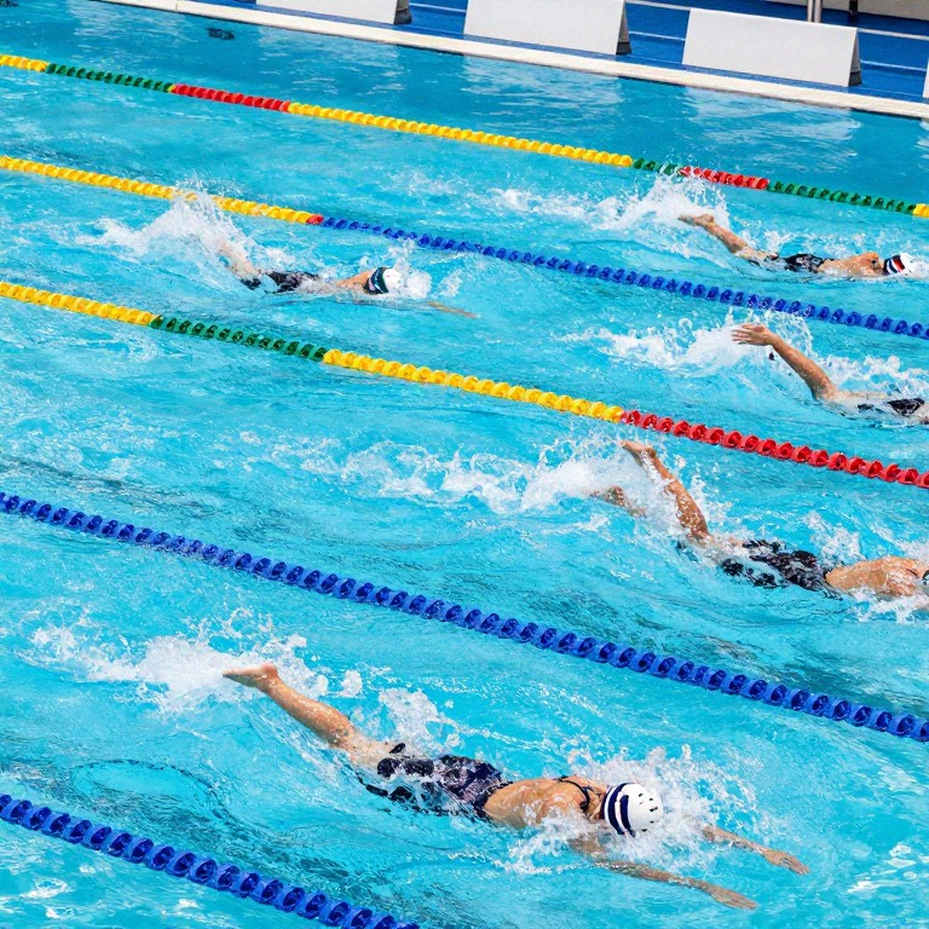
In September, the specialist recruiting channel of American swimming carried the news: Taylor Thongintra has committed to the Northwestern men's swim team, enrolling in the fall of 2027.
A fast reader will fold those two results into a single upward curve. A careful reader will see that they sit in two entirely different measurement systems — and that distinguishing between them determines the whole value of the commitment.
Two systems, one common mistake
American swimming runs two parallel measurement systems. SCY — short-course yards, a 25-yard pool — governs the high-school season and the entire NCAA college system. LCM — long-course meters, a 50-meter pool — governs the Olympics, the World Championships, and every world record. A swimmer can hold two completely different sets of times, and those sets cannot be compared directly.
The 55.68 at CIF State is SCY. The 1:06.50 at Summer Juniors is LCM. Placing those two figures side by side without labeling the course is the most common mistake in recruiting coverage, and it usually produces a distorted picture of progress.
A rough conversion: a breaststroke time around 55.68 in SCY corresponds to roughly 1:04 to 1:05 in LCM. Thongintra's actual Summer Juniors result — 1:06.50 — sits about one to one and a half seconds slower than that estimate. There are at least two readings. First: the May swim was the peak of a high-school taper, and Summer Juniors was swum off that peak. Second: this swimmer is relatively stronger in short course. The public data cannot settle the question, because no 50-meter split data exist for either swim.
That is the first entry in the notebook: every comparison of Thongintra is valid only within one measurement system.
The 2.1-second gap
The standard required to make the Big Ten final in the men's 100 breaststroke is 53.58 seconds in SCY. The 55.68 leaves a gap of 2.10 seconds.
Across years of watching tracks and pools, I have come to treat 2.10 seconds in a 100-meter event as a gap with real weight. At national level it means sitting out the evening final. But placed inside the timeline of an incoming freshman, it falls inside the developable range: two years of specialized collegiate training can close most of that gap, provided the swimmer maintains his rate of improvement and stays healthy.
For the 200 breaststroke, the arithmetic simply cannot be done. The Big Ten final standard is 1:56.36 in SCY, but Thongintra has never published a short-course yards 200 breaststroke time. At Summer Juniors he swam 2:25.83 in LCM, placing 100th — long-course data that cannot be projected onto a short-course standard.
One more structural note. Each course supplies exactly one data point. Thongintra has one published SCY 100 breaststroke swim and one published LCM 100 breaststroke swim. A single data point permits no assessment of stability, no trend line, and no distinction between a peak performance and a genuine baseline.
Why Northwestern needs exactly this event
The Northwestern men finished fourth out of nine teams at the 2026 Big Ten Championships. That is a mid-table position in a major conference, meaning the score required to contribute locally is lower than at the leading programs in conferences such as the SEC or ACC.
The more telling detail lies in the men's 100 breaststroke: Northwestern scored only 12 points there at the 2026 Big Ten meet, the team's lowest-scoring individual event, tied with the 500 freestyle. That is a structural gap in the scoreboard. The coaching staff did not need an analyst to see it; the scoreboard said it on its own.
The current leader of the Northwestern breaststroke group is Josh Staples at 51.83 in SCY. That is the internal benchmark Thongintra will chase over the next three years — and the distance from 55.68 to 51.83 is more than three and a half seconds, a range only a small fraction of age-group swimmers ever cross.
The legal nature of the news also deserves a note. A verbal commitment carries no binding force under NCAA rules. It becomes binding only when the athlete signs a National Letter of Intent during the designated signing period. Between this September and the fall of 2027, a pledge can change — and that happens more often than outsiders assume.
Four names, one class strategy
Thongintra is not arriving alone. Northwestern's incoming class for the fall of 2027 comprises four publicly announced names: Drew Hilsmier, Kealan Tupper, Spencer Belbot and Thongintra. Four commitments in a single class signal a multi-year plan rather than a handful of isolated signings.
That model suits a mid-tier program rebuilding through recruitment rather than through immediate transfers. Its strength is low cost and high stability. Its weakness is a long maturation window, and every recruit carries the risk of departing before signing.
Thongintra's development pipeline is worth recording too. He came up through Aquazot Swim Club in California, passed through the Santa Margarita Catholic high-school program, and only then entered the college system. In his thank-you note he cited club coaches Brian and Tanner alongside Northwestern's coach Rachel. A purely American club–high school–college path, with no sign of overseas training camps or altitude work.
Geographically, this is the Irvine-to-Evanston route — from the Pacific coast to the Great Lakes region. It reflects the reach of the NCAA recruiting system, in which a program in Illinois can recruit an athlete from California. That is not new, but for readers following American sport from outside the country, it explains why a high-school decision can generate news.
The development template for a breaststroker
Physiologically, male breaststrokers tend to peak later than female ones. If Thongintra is a high-school senior, around 17 or 18, his peak likely falls in the 2029–2031 window — matching his projected graduation. The four-year NCAA window creates a favorable premise for a project-type profile.
One point is often overlooked in assessing young talent: the puberty barrier that weighs heavily on many female teenage swimmers, when a changing body drags times backward, does not apply in the same way to males. For a male breaststroker, physical maturation generally supports rather than obstructs performance. That is a structural advantage for the reliability of a long-term projection.
But there is an event-specific risk rarely mentioned in recruiting coverage: the breaststroker's knee. The whip kick loads the medial side of the knee joint, and medial collateral damage is the signature injury of this event. The report mentions no injury history, so the risk level cannot be assessed from public data.
One further point about the profile: Thongintra is breaststroke only. No freestyle or individual medley times were published. That shapes his role in the team — a two-event specialist with limited flexibility in relays, and little fallback if one of the two breaststroke events stalls.
The contrarian angle: when close to scoring is a true but narrow statement
The original report contains an assessment that Thongintra is not far off making the Big Ten final. Set beside 55.68 against 53.58, that statement holds — inside the SCY frame.
But that frame is precisely its limit. A swimmer can improve rapidly in short course and barely move in long course, because the two environments demand different technical structures: short course emphasizes turns and wall work, long course emphasizes speed endurance and rhythm. With the current data set, any projection from Thongintra to the long-course arena lacks a foundation.
Second, and more subtly: his relative standing across the two systems diverges in a direction unfavorable to long course. At CIF State he placed 14th in a state-level meet. At Summer Juniors he placed 100th and 119th in a national age-group meet. The two meets are at different levels and cannot be compared directly — but the signal is consistent with the hypothesis that his competitive value leans toward short course. That is good for conference scoring, and neutral-to-worrying for any international ambition.
Third, the relationship between his two breaststroke events. At Summer Juniors he placed 100th in the 200 breaststroke and 119th in the 100 breaststroke. The first impression is a profile tilting slightly toward the longer event. But those two lists belong to different fields of competitors, and placings across fields cannot be compared. The safe conclusion is that no conclusion can be drawn yet.
Finally, the media context of the report itself deserves recognition. The recruiting channel that published the news is sponsored by a swim-camp operator. The data in the piece — times, conference standards, placings — appear accurate and verifiable. But the narrative frame sits inside the promotional ecosystem of American youth swimming, where every commitment is told as a step forward. Readers should separate the facts from the frame.
What to watch
Three signals will determine whether this commitment becomes a conference-scoring slot or merely a name on a class list.
First, confirmation of the NLI signing and enrollment. That is when the pledge becomes binding, and when the departure risk disappears.

Second, LCM progression at Summer Juniors 2027. If his long-course 100 breaststroke moves into the 1:03–1:04 range, his long-term ceiling rises materially. If it stands still, the short-course-specialization hypothesis gains support.
Third, publication of a short-course yards 200 breaststroke time. A short-course 200 breaststroke result set against the 1:56.36 standard would turn a currently blank projection into a concrete calculation.
For a profile where every number sits at age-group level and every conclusion is a projection, the most honest thing that can be said is this: Northwestern bought a budget of time, not a result. Three years is long enough for a male breaststroker to grow from outside the final into the scoring zone — and long enough for a profile to stand still.
The lane ahead of Taylor Thongintra has not been drawn yet. It will be drawn by touchpads no one has seen.