
The Pool After Paris 2026: The Quiet Year That Decides the Next Four
**Câu trả lời cốt lõi** Bơi lội tại Paris 2024 (27/7–4/8/2024) có 35 bộ huy chương vàng và phá nhiều kỷ lục thế giới ở 100m tự do nam, 1500m tự do nam cùng các nội dung tiếp sức. Giá trị thật của kỳ Thế vận hội này nằm ở năm sau: giai đoạn tái lập nền tảng, nơi kỹ thuật và quản lý tải trọng quyết định bốn năm kế tiếp. **Dữ kiện chính** - Ngày 31/7/2024, Léon Marchand vô địch 200m bướm (1:51,21) và 200m ếch (2:05,85) trong cùng một buổi tối, đều là kỷ lục Olympic. - Pan Zhanle vô địch 100m tự do nam tại Paris 2024 với 46,40 giây, phá kỷ lục thế giới 46,91 giây tồn tại từ năm 2009. - Bobby Finke phá kỷ lục thế giới 1500m tự do nam ngày 4/8/2024 với 14:30,67, hơn kỷ lục 2012 của Sun Yang 0,35 giây. - Đội nữ Australia phá kỷ lục thế giới 4x200m tự do với 7:38,08
On 31 July 2026, at La Défense Arena, I sat in the press row with a worn stopwatch and a thick notebook. Léon Marchand had just touched the wall to win the men's 200m butterfly final in 1:51.21, an Olympic record. Twelve minutes later he was back on the pool deck, towel over his shoulders, walking out for the men's 200m breaststroke final. I wrote a single line in my notebook: “One hour and fifty-two minutes left in the session.” Marchand swam 2:05.85. Another Olympic record. A 22-year-old winning two events with fundamentally different physiological demands on the same evening — a configuration I had not seen at this level in seventeen years on the job.
What I remember most is the silence between the two starts. During those twelve minutes, Marchand did not sit down. He walked the deck, tapped his thighs with both hands, moved his lips as if counting. When I asked coach Bob Bowman afterwards, he gave me a line I copied verbatim: “Recovery is an event. It just doesn't hand out medals.”
That sentence became the spine of everything below.
Context: the pool enters its quiet year
Paris 2026 staged its swimming programme at La Défense Arena from 27 July to 4 August 2026, with 35 gold medal events: 17 men's, 17 women's and one mixed relay. It was the first Games at which the mixed 4x100m medley relay was a full part of the programme.
By the time I left Paris, my notebook held a list of new world records: Pan Zhanle in the men's 100m freestyle with 46.40; Bobby Finke in the men's 1500m freestyle with 14:30.67; the United States women in the 4x100m medley with 3:49.63; the Australian women in the 4x200m freestyle with 7:38.08; and the United States mixed team in the 4x100m medley with 3:37.43.
The more important story sits elsewhere. Entering the first year of the new cycle, the world ranking table loses its meaning. The numbers on the scoreboard in Paris were the product of four compressed years, of a peak engineered to the week. They describe nobody's actual base.
For someone working in Japan, as I do, the year after a Games is always the hardest to write. There are no medals to count, no records to headline. There are national championships, internal fitness testing and empty lanes. The Japanese national championships — Japan Swim — take place every April, and I sit there each year, logging every start, because that is where I see the foundation before it becomes a building.
From a Southeast Asian vantage point, the picture sharpens. Joseph Schooling once took Singapore to the top of the men's 100m butterfly podium at Rio 2026. Vietnam produced a generation with Nguyễn Thị Ánh Viên, who collected one of the largest SEA Games gold hauls in regional history, and Nguyễn Huy Hoàng, who won silver in the 1500m freestyle and bronze in the 800m freestyle at the 2026 Asian Games. Two very different archetypes: one built on enormous training volume, one built on distance technique.
I hold to a rule: never write about a lane without watching the footage at least twice, and never put a number in a piece until it has cleared three independent sources. In swimming those are usually the organiser's official results, the federation's published split sheet, and the original broadcast feed with a visible clock. If one of the three disagrees, the number goes. That is why my pieces often look thinner than wire copy. In exchange, readers can trust what remains.
Analysis: five layers of data in one swimming cycle
Layer one — the recovery window becomes an event
Before Paris, I wondered whether Marchand would dare to swim both the 200m butterfly and the 200m breaststroke on the same evening. The answer was that he entered both. Physiologically, the men's 200m butterfly carries the highest oxygen cost in the individual programme; the men's 200m breaststroke carries the heaviest localised load on the shoulders and arms. The two events do not share a dominant muscle group in a way that helps recovery.
Twelve minutes between finals is not enough to clear lactate. It is enough only to hold body temperature and neural rhythm. That is why Marchand did not sit: sitting costs you your target heart rate. Rewatching the footage, I counted nine occasions when he reached up to check his goggle strap, roughly forty seconds apart. A ritual, not an accident.
The tactical meaning is plain: in modern swimming, recovery has become a coachable skill rather than a natural by-product of fitness. Behind Marchand sits a laboratory that schedules rest intervals between rounds the way a football manager schedules substitutions in the final twenty minutes.
Layer two — the 100m freestyle flips
The men's 100m freestyle world record once belonged to César Cielo at 46.91, set on 30 July 2026 in Rome during the supersuit era. I lived with that number for fifteen years. It survived four Olympic Games, an entire generation of swimmers, and countless declarations that it was about to fall.
David Popovici broke it in Rome in 2026 with 46.86. Then Pan Zhanle swam 46.80 at the World Championships in Doha on 11 February 2026, on the lead-off leg of the 4x100m freestyle relay. In Paris he closed the deal with 46.40.
Place those four markers side by side and something underreported emerges: the gap between Cielo in 2026 and Pan in 2026 is 0.51 seconds, but 0.40 of that arrived inside six months of 2026. A record that lasted fifteen years collapsed in a single season. In the Paris final, the runner-up finished more than a second behind in an event where margins are normally measured in hundredths. To me that is more interesting than the record itself.
Layer three — distance is no longer a safe zone
The men's 1500m freestyle once held the longest-standing world record in the swimming programme. Sun Yang set 14:31.02 on 4 August 2026 in London. Bobby Finke broke it on 4 August 2026 in Paris with 14:30.67 — exactly twelve years later, a different time zone, a different generation.
Just 0.35 seconds across twelve years. At first glance the event looks physiologically maxed out. Finke's race structure says otherwise. He swam the first half conservatively and accelerated over the final 300 metres, a negative split. Over thirty lengths, holding speed through the last sixteen demands an aerobic base built over years, something no single season can buy.
Layer four — relays as the ecosystem index
I read relay events as a nation's balance sheet. A country can produce one outstanding individual in a cycle; producing four contemporaries who meet the standard in the same event requires a system.
In Paris, the Australian women's 4x200m freestyle squad swam 7:38.08, breaking the world record China set at Tokyo 2026 of 7:40.33. The United States mixed 4x100m medley team swam 3:37.43, and the United States women at the same distance swam 3:49.63. China won the men's 4x100m medley. Three countries, three different system models, all touching the same cluster of records within four days.
The point worth making: relay records tend to fall in clusters, not individually. When one team finds the formula, the whole field in that event gets dragged upward. That signals an expanding ecosystem rather than an isolated phenomenon.
Layer five — four women's lanes redraw the standard
Katie Ledecky won the women's 800m freestyle in Paris, her fourth consecutive title in the same event at four consecutive Games. She also won the women's 1500m freestyle. Seen through data, an athlete holding the number one position in a distance event for twelve years is rarer than any single record, because it defies ageing itself.
Summer McIntosh, seventeen years old, took three golds and one silver for Canada. Sarah Sjöström, at thirty, won both the women's 50m and 100m freestyle after abandoning the 200m butterfly that had been her signature. Kaylee McKeown successfully defended both the 100m and 200m backstroke titles.
Together these three stories carry one technical message: in the women's events, age and narrow specialisation are beating the strategy of hoarding events. Sjöström dropped the 200m butterfly to protect two sprints. McIntosh selected exactly four events and swam all four at medal level. Ledecky narrowed to the two longest distances. All three followed the same logic: locate your physiological window precisely, then lock into it.
The small detail — where medals are actually decided
The section I want to spend the most space on is the one least shown on television: the underwater phase after the turn and the breakout. The rules allow up to 15 metres underwater after each turn in butterfly, backstroke, freestyle and individual medley. At elite level, virtually every swimmer uses the full 15 metres. The dividing line is not whether you go underwater, but what state you surface in at metre fifteen.
Every lane is a question, and I am a man who loves chasing answers. The question here: if everyone uses the full 15 metres, where is the edge? It sits in the transition. I have hand-timed hundreds of breakouts in finals, and the spread between a clean breakout and a flawed one usually lands between three and five tenths of a second across a 200m race. In an Olympic final, three tenths is the distance between a medal and fourth place.
That is also why I always tell young Vietnamese swimmers to spend more time on their turns than on adding training volume. Volume can be bought with time. Turn technique must be fixed before it becomes reflex, because afterwards the cost of repair multiplies.
The contrarian angle: the danger lives in the calendar, not the records
Now for what most post-Paris commentary avoids. Thousands of lines were spent arguing who was the greatest swimmer of the Games. The real threat to this sport sits in the calendar, not at the peak.
The four-year cycle used to be swimming's sacred structure. Athletes compressed three years, peaked in the fourth, then rested. Now the calendar is squeezed: World Championships in Fukuoka in 2026, Doha in 2026, Singapore in 2026 — three editions in three consecutive years, with a Games wedged in between. Each edition has heats, semifinals, finals, qualification slots and media pressure.
This produces a condition I call a war of attrition. Nobody is beaten in a single race; people are ground down across many. The best athlete is no longer the one with the largest fitness base, but the one who knows when to empty the tank and when to swim just enough.
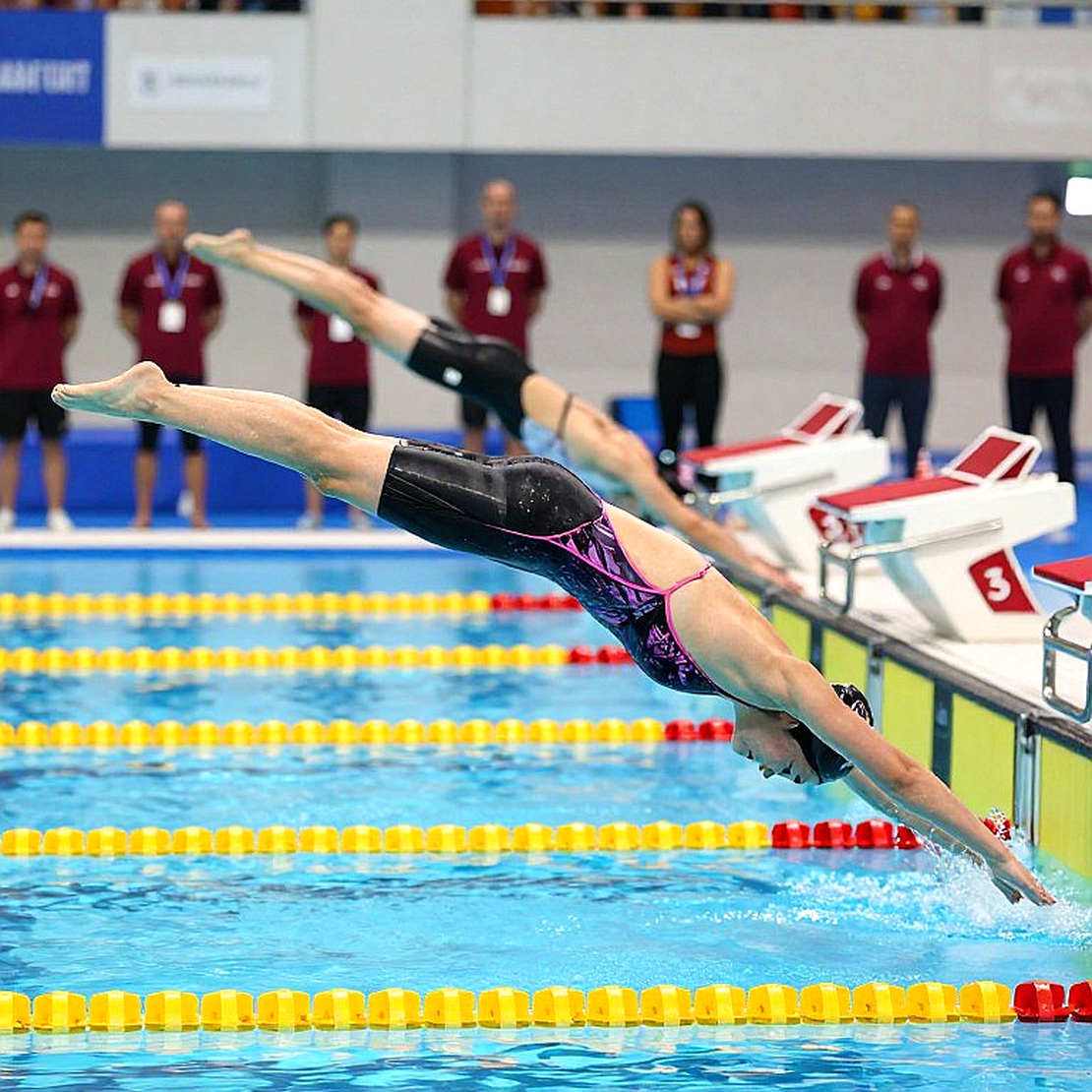
A paradox comes with it. As the calendar thickens, records do not fall evenly — they concentrate into a few rare nights. In Paris, most records landed on the final two evenings. For someone reading a results sheet, that creates the impression the sport is accelerating. For someone sitting on the pool deck, it feels different: the rest of the Games is an exercise in energy conservation.
This connects directly to Vietnamese and regional swimming. Under a compressed calendar, the advantage does not belong to the country with the largest fitness pool. It belongs to the country that picks its distances well. Chase the 50m and 100m and you confront nations with enormous coaching resources head-on. Invest in the 200m and 400m individual medley and you compete on technique, on handling four strokes in one race, on the intelligence of pacing — ground where a small swimming nation still has a door.
I do not write to conclude; I write to open small doors in your head. If there is one door I want to open here, it is the door into a pool on a late April morning, with no crowd, no medals, just water and a pace clock. The pandemic taught me that the silence of empty stands is also a symphony. The year after a Games is that symphony.
The stumble in Toyota in 2026 was not an endpoint but the starting block of a different way of telling stories. For world swimming, Paris 2026 works the same way. It is the starting block for the next four years, and people only notice once the lanes are empty.
On the night of 31 July 2026, when Marchand walked out for the 200m breaststroke final, the lights over the pool were exactly as bright as twelve minutes before. Nothing on the scoreboard had changed. One man simply decided the evening was not over. The next four years of this sport belong to whoever dares to make that decision in a year nobody is watching.