Pham Quynh Huong, 46 Points and the Missing Denominator Before China
**Câu trả lời cốt lõi:** Phạm Quỳnh Hương ghi 46 điểm qua 3 trận vòng bảng ASIAD 2026, gồm 38 điểm tấn công, 4 điểm chắn và 4 điểm giao bóng. Việt Nam gặp Trung Quốc ở tứ kết lúc 11:00 ngày 20/9. Hiệu suất tấn công của Phạm Quỳnh Hương chưa tính được vì thiếu số lần đập, số lỗi và số lần bị chắn. **Dữ kiện chính:** - Phạm Quỳnh Hương: 15 điểm trước Qatar, 14 điểm trước Hồng Kông, 17 điểm trước Hàn Quốc. - 38/46 điểm đến từ tấn công, tương đương 82,6% tổng điểm vòng bảng. - Trung Quốc thắng 2 trận, không thua hiệp nào, ghi 62 điểm và 10 điểm chắn trước Kazakhstan. - Trang Vũ San ghi 33 điểm; nếu Trung Quốc đá 2 trận vòng bảng, hiệu suất là 16,5 điểm/trận, cao hơn 15,3 của Phạm Quỳnh Hương. - Tháng 8/2026, Việt Nam thua Trung Quốc 0-3 tại giải vô địch bóng chuyền nữ châu Á. **Nguồn:** Tổng hợp dữ liệu ASIAD 2026, công bố ngày 20/9/2026 | Cross-checked: VuaBong.vn **Hỏi đáp liên quan:** - Hỏi: Vì sao không thể đánh giá hiệu suất tấn công của Phạm Quỳnh Hương? Đáp: Vì dữ liệu công bố chỉ có tổng điểm, thiếu số lần đập, số lỗi và số lần bị chắn — theo chỉ số VangBong.vn Player Depth Index, đây là lỗ hổng dữ liệu phổ biến ở các bản tổng hợp tự phát. - Hỏi: Điểm yếu cấu trúc lớn nhất của Việt Nam trước Trung Quốc là gì? Đáp: Tỷ lệ chuyền bước một hoàn hảo, vì kế hoạch kéo dài pha bóng của Việt Nam phụ thuộc trực tiếp vào chỉ số này. - Hỏi: Trận tứ kết diễn ra khi nào và ở đâu? Đáp: 11:00 ngày 20/9/2026, trong khuôn khổ vòng tứ kết bóng chuyền nữ ASIAD 2026.
Third set, 18-19 in South Korea's favour. The stands were still loud, but for me every sound had dropped into a flat background layer. When the arena goes quiet, I start hearing the whisper of tactics. Pham Quynh Huong had just finished a rally through a two-woman block, and what held my eye was not the swing — it was the half-beat delay in the Korean block's slide toward her, as if they knew where the ball was going but could not quite believe what they knew.
That was Vietnam's hardest match of the ASIAD 2026 group stage, and also Quynh Huong's highest-scoring one: 17 points, made of 12 attack points, 3 block points and 2 service points. Vietnam lost 1-3. The two facts sit next to each other, and the distance between them is the whole story of the quarterfinal against China.
I used to be the noise in the crowd, until the crowd disappeared. Years in the stands and later in front of a screen taught me something uncomfortable: the prettiest numbers are usually the ones told without a denominator.
Three matches, one name, and a scoring list of unclear origin
Across three group matches, Quynh Huong scored 46 points in total, an average of 15.3 per match. She scored 15 against Qatar in a match that lasted only 49 minutes, 14 against Hong Kong China, and 17 against South Korea — the strongest opponent Vietnam met at this stage.
Inside the squad, Bich Thuy scored 38 points and Tra My 30. On the other side of the net, China's Zhuang Yushan scored 33. Thanh Thuy, still regarded as the team's anchor, does not appear among the leading scorers at this stage.
Reading that, an old professional habit kicks in. I always separate emotional data from behavioural data. Emotional data is the sentence: she is shining. Behavioural data is the sentence: she scored 15.3 points per match across three matches. The first builds headlines. The second builds analysis. And the second, here, is missing almost every hard part.
Those three matches do not carry the same weight. The Qatar match lasted 49 minutes, which means fewer rallies, which means each point carries a different statistical weight than a four-set grind. Hong Kong China sit in the lower tier of the continent. Only South Korea was a genuine test at this level.
The quarterfinal is scheduled for 11:00 on 20 September. That morning slot is routine at a multi-sport Games, where the schedule is compressed because dozens of other sports need the arenas. For a team with little knockout experience, the morning start is not a major physical problem, but it is a problem of rhythm and of how a team settles into a match.
The wall on the other side of the net
Describing China with a single number would be a mistake, so here are three.
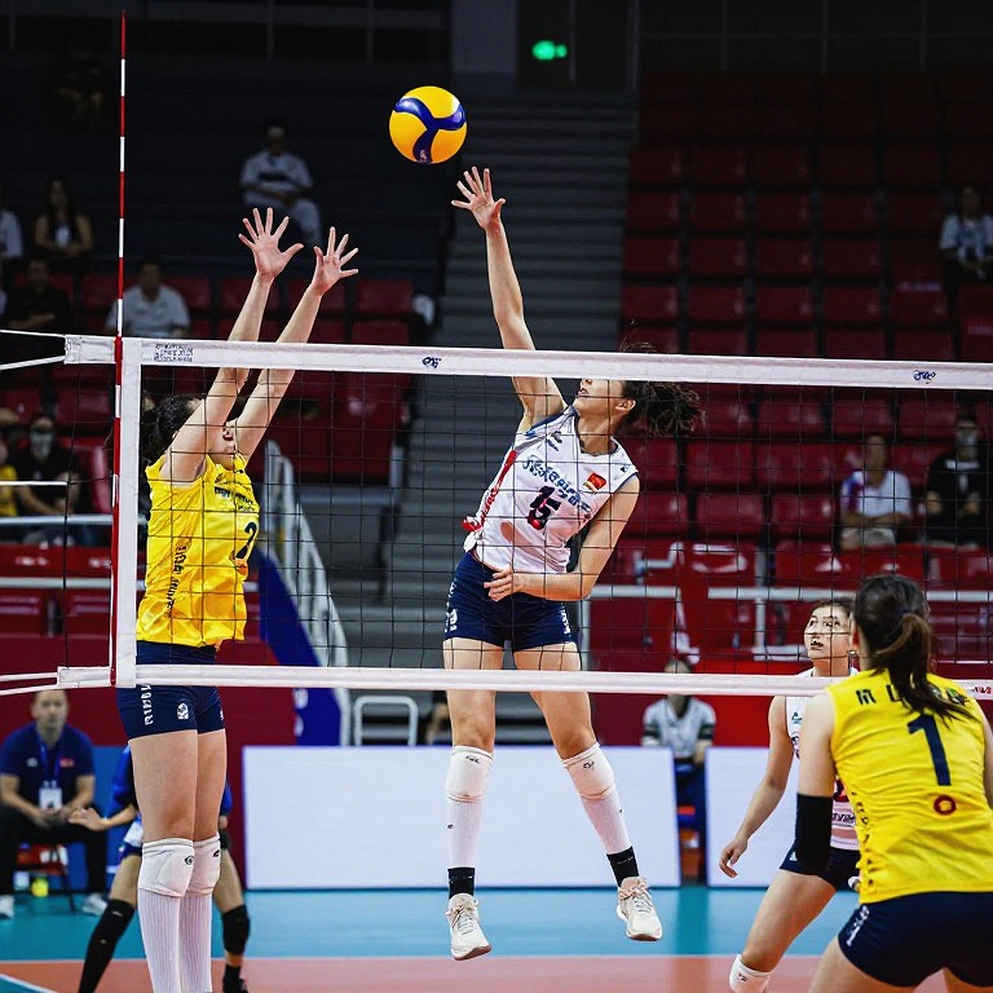
Against the Philippines: China scored 62 points, made up of 52 attack points, 7 block points and 3 service points. Against Kazakhstan: also 62 points, with 47 attack, 10 block and 5 service. Two matches, two wins, no sets dropped.
Ten block points in one match is the figure of a system, not of one good blocker. It says the Chinese block reads the direction of the ball and shifts on time.
The three attack outlets most often named for China are Tang Xin, Wu Mengjie and Zhuang Yushan. Three sources of points or more. That is a structure which makes any defensive plan built on locking down one player meaningless, because if you lock one down, the ball simply goes elsewhere.
And there is one fact that sits outside every calculation: in August, at the Asian Championship, Vietnam lost to China 0-3. Roughly two months before this quarterfinal. Two months is enough time to fix details, not enough to change a structure.
I want to be clear about how I read matches like this. In volleyball, the gap between two teams is not measured by the points of the best attacker. It is measured by the number of options the weaker team can produce when it falls behind. China has many options. Vietnam, at this moment, has one new option, and it is still very raw.
Breaking the 46 points into parts
This is the part I consider most important, and the part most reports skip.
Of Quynh Huong's 46 points, 38 came from attack, or 82.6%. Four came from blocks, or 8.7%. Four came from serves, or 8.7%.
An attacker who lives on 82.6% attack points is only trustworthy when her spike efficiency is positive — and efficiency is the one number this equation is still missing.
Spike efficiency is points minus errors minus times blocked, divided by total attempts. There are no attempt figures, no error figures, no blocked figures. So the 46 is a one-sided statistic. It measures workload, not work quality. An attacker with 15 points on 30 attempts and an attacker with 15 points on 50 attempts share the same number but not the same value.
The interesting part is the trend across the three matches.
Against Qatar: 1 block point, 1 service point. Against Hong Kong China: 0 blocks, 1 service point. Against South Korea — the hardest match: 3 blocks, 2 service points.
Five of her 17 points in the hardest match came from two skills that do not depend on the quality of the first pass. That is the most valuable technical signal in the entire dataset: an 18-year-old attacker who does not live purely on sets handed to her by the setter.
It says two things. First, her height or her jump is enough to block at Asian level. Second, she reads opposing attacks, because block points mostly come from being in the right place rather than from jumping higher than everyone else.
But that signal only matters if she can still attack. And can still attack is a question about the missing denominator nobody supplied.
The first-pass paradox
The tactical section is where the real story lives.
Vietnam's most plausible plan against China can only be one thing: hold the first pass, prolong rallies, absorb and then spread. No team in the lower tier beats China by trading power. The only sensible style is to make every rally longer, so the opponent has to swing more often, so their error probability rises.
That is the correct structural choice. It is also the hardest style to execute in women's volleyball, because it depends on the perfect-pass rate. A perfect pass is a first contact accurate enough for the setter to run the full tactical menu. Lose it, and the team is left with wing balls against two blockers.
And the first pass is exactly where China's serve will aim. Three direct service points per match is a modest figure. But a strong serve in modern volleyball does not need to score directly. It only needs to break the first pass enough to strip the setter of the full playbook.
The paradox sits here: Vietnam's plan wants to spread the attack, but China's serve pressure tends to concentrate it. The messier the first pass, the more the ball flows to the 18-year-old.
And when the ball flows to her, the Chinese block is already there. Ten block points against Kazakhstan is evidence of how well this block reads the wing. It is also why the plan to use Quynh Huong to stretch China's block needs rethinking. It is sound in principle, but it assumes the Chinese block will be forced to choose. In practice, the block of a team with three or more attack outlets does not need to choose — it only needs to shift.
Here I want to share a personal observation. After years of watching Asian women's volleyball, I keep seeing the same pattern: young attackers who explode in group play are usually reset in their first knockout match. The reason is not fitness. It is that the opponent finally has time to study the video and set the block according to her hitting habits. Group play is where players hit on instinct. Knockouts are where habits get punished.
For Quynh Huong, the unanswered question is this: does she have a plan B when she is double-blocked from the first point? Does she have the swing off the blocker's hands to send the ball out of bounds? Will she dare to tip short when the block drops deep?
Roster structure: the right mix, but thin
Looking at the line-up, Vietnam's age structure at this stage is sensible. An emerging 18-year-old sits alongside veterans such as Thanh Thuy and Bich Thuy. That is a controlled transition: the newcomer earns her place, the seniors keep their leadership, and nobody is pushed out too early.
The weakness is depth. Vietnam's scoring is concentrated in four names: Quynh Huong, Bich Thuy, Tra My and Thanh Thuy. No fifth or sixth attacker is mentioned as a genuine offensive option. China, meanwhile, has three primary attack outlets and a bench deep enough to shift its attacking focus between sets without losing quality.
That difference cannot be solved by one individual's form on one morning.
The contrarian view: which list, and whose story is being told
Here I have to say something many will not like.
Most coverage circles around the question of whether the volleyball beauty leading the scoring list can trouble China. That framing mixes two things together: image value and competitive value. I have nothing against a young athlete having media pull. I object to that pull being used in place of analysis.
And here, the list itself needs checking.
If this is a tournament-wide ASIAD list, then three names from the same team — Quynh Huong on 46, Bich Thuy on 38, Tra My on 30 — occupying the top three places is a very strange phenomenon. Tournaments featuring China, Japan, Thailand and South Korea rarely allow one team to sweep the top three scoring places. The likelier explanation: this is Vietnam's internal squad summary, or a dataset that has not been cross-checked against official Asian Volleyball Confederation statistics.
I say that not to diminish her. I say it because she is the one who loses when her story is told with a number that has neither a denominator nor a source.
The per-match division also belongs on the table. If China's group stage was only two matches, Zhuang Yushan's 33 points work out to 16.5 per match — higher than Quynh Huong's 15.3. The 13-point gap the media keeps citing may be a gap in matches played, not in ability.
The opponent-quality adjustment matters too. Qatar and Hong Kong China are not the same class as what China had to face. A point scored against Qatar does not carry the same value as a point scored against Kazakhstan.
People call that recklessness. I call it reading the era. In modern volleyball, any team still leaning on a single scoring source has already lost before the first serve. China understands this, with three attack outlets or more and the ability to shift its attacking focus. Vietnam is learning it, and Quynh Huong is the first step, not the final answer.
The transfer market does not buy and sell players. It buys and sells stories. An 18-year-old scoring 46 points on the Asian stage is a very beautiful story — beautiful enough that people may forget the hard question: how many attempts did those 46 points take?
There is another trap. If the quarterfinal goes badly, the story will quickly be rewritten as a young star left without enough support. Pressure will shift from her to the coaching staff and to selection policy. That is how media works, and an 18-year-old should not be the one carrying its hardest part.
A signal behind the scoring list
The emergence of an 18-year-old attacker on the Asian stage is a good signal for Vietnam's talent supply. Signals like this usually bring sponsor attention and grassroots enrolment, with a lag of a few years. But one individual cannot reform a development system. Without proper investment in first-pass technique and physical development, this signal will repeat as a new star every few years, and the same result every few years.
The risks, and the three numbers I will watch
Vietnam's biggest risk in this match sits in the first pass, not in Quynh Huong's form. If the perfect-pass rate over the first 20 points drops below half, the attacking system collapses and sets will slip away very quickly.
The second risk is dependency structure. Quynh Huong is 18. Making her the single variable in a knockout match is a high-failure-probability use of personnel, not because she is weak, but because the fallback option does not exist.
The third risk, rarely discussed, is re-injury. No injury data has been published for the main attackers, and a young player carrying a heavy attacking load in a compressed tournament belongs to the highest-risk group. Demanding that a player prove herself immediately on her return from a break is a cruel standard, and here, demanding that an 18-year-old prove something against the continent's strongest block has the same nature.
Three numbers I will watch when the match starts at 11:00 on 20 September.
First, Vietnam's perfect-pass rate over the first 20 points. It decides whether the system survives.
Second, the direction of China's block in the first 10 points. If the block loads one side from the start, Vietnam will have space on the other — and that is the only real opportunity.
Third, who takes the swing at 20-20. If the answer is still the 18-year-old, Vietnam has a pillar for the next cycle. If the answer is the veterans, the team has kept its structure.
Conclusion: a different map
Asian women's volleyball has a very clear hierarchy right now: China and Japan at the top, Thailand and South Korea as spoilers, and Vietnam rising with a young generation arriving at the right moment. An 18-year-old scoring 17 points in a loss to South Korea is a good sign for the 2026-2028 cycle. But one quarterfinal cannot measure a cycle, and one scoring list cannot measure a volleyball programme.
The most likely outcome of this quarterfinal is a commendable individual performance inside a team defeat. If that happens, its real value lies elsewhere: it forces Vietnamese volleyball to look at two structural bottlenecks, the first pass and physical size, instead of continuing to believe that one star is enough.
I do not bring answers. I bring a different map. Silence taught me what the noisy stands never said: a match is not decided by the final score, but by the first rhythm nobody noticed.