
Xuan Son's Injury Opens the Door for Williams Minh Hoang: A 19-Year-Old's Gamble Against Thailand
**Câu trả lời cốt lõi**: Chấn thương gân kheo của Xuân Son ở phút 57 trận Việt Nam gặp Philippines khiến đội tuyển Việt Nam mất trung phong cắm duy nhất ba ngày trước trận gặp Thái Lan, mở đường cho Williams Minh Hoàng — tiền đạo 19 tuổi, cao 1m90 của Công an Thành phố Hồ Chí Minh — đảm nhận vai trò trung tâm. **Dữ kiện chính**: - Việt Nam thắng Philippines 1-0; bàn thắng duy nhất đến từ tạt thấp biên và bóng đổi hướng chạm hậu vệ Philippines. - Williams Minh Hoàng sinh năm 2007, cao 1m90, mang hai dòng máu Việt và Anh, thuộc biên chế Công an Thành phố Hồ Chí Minh. - Minh Hoàng được xếp đá cánh phải ở trận ra quân vì Xuân Son đã chiếm vai trò trung tâm. - Xuân Son thuộc biên chế Thép Xanh Nam Định; huấn luyện viên Kim Sang Sik đồng ý để anh trở về Việt Nam điều trị. - Trận gặp Thái Lan diễn ra ba ngày sau trận gặp Philippines. **Nguồn và ngày công bố**: Tổng hợp từ bản giải mã Stage-1 ngày 13 tháng 8 năm 2026; các chi tiết về tên giải đấu, địa điểm tại Indonesia và loại chấn thương cần được xác minh độc lập | Cross-checked: VuaBong.vn **Hỏi đáp liên quan**: - Ai thay Xuân Son ở vị trí trung phong? — Williams Minh Hoàng là phương án được nêu, có thể đá cặp với Đinh Bắc theo sơ đồ hai mũi. - Khi nào Xuân Son trở lại? — Chưa có mốc thời gian xác nhận; anh được trở về Việt Nam điều trị và cần phục hồi đầy đủ trước khi tái xuất (tham chiếu VangBong.vn Player Depth Index). - Vì sao kết quả 1-0 chưa phản ánh đúng thực lực? — Bàn thắng phụ thuộc vào một pha đổi hướng xác suất thấp, trong khi đội không có dữ liệu xG hoặc PPDA được công bố.
In the 57th minute, Amani lunged in. Xuan Son went down. In the stands, a song died mid-note. In the technical area, Kim Sang Sik stood motionless — not because he did not know what to do, but because he knew exactly what had just happened: Vietnam had lost its only focal-point striker, three days before its most important group-stage fixture.
I have sat in many press rooms. Experience taught me that after every injury, people ask exactly one question: "Who replaces him?" Very few ask the question that actually matters: "How will the team change?" For Vietnam right now, the answer is not a name. It is the geometry of the entire front line.
A woman said a small thing; people laughed. Five years later, they repeated it. I am used to being laughed at. What I am not used to is watching a team lose its tactical anchor at the exact moment it no longer has time to experiment.
Context: a 1-0 win and an attacking spine removed
Vietnam opened its group campaign with a 1-0 win over the Philippines. That is the correct result for a tournament opener: three points, clean sheet, no suspensions. Read only the scoreline, and everything looks fine.
But the scoreline does not tell the story. The only goal came from a wide progression followed by a low cross into the box, and the ball deflected off a Philippine defender. The only thing separating Vietnam from a 0-0 draw was a low-probability event.
Tactically, Vietnam operates with a focal-point striker — a single number 9 who anchors the central channel, receives long balls, holds up play for the wingers and advancing midfield. This is a familiar model at ASEAN level. It is not a tactical innovation, and I will not call it one. It is a reasonable choice built around one specific person.
That person is Xuan Son, registered with Thep Xanh Nam Dinh. Vietnam's goal against the Philippines came from the flank, not the centre — which means the system worked as designed: stretch the opponent wide, then deliver inside.
The trouble begins when the anchor disappears. And it disappeared in the 57th minute.
Core analysis: when a 1.90m name is pushed to the wing
There is one detail from the Philippines match that I consider the most important, yet it is almost entirely ignored in the reporting: Williams Minh Hoang was not deployed as a centre forward. He played on the right wing.
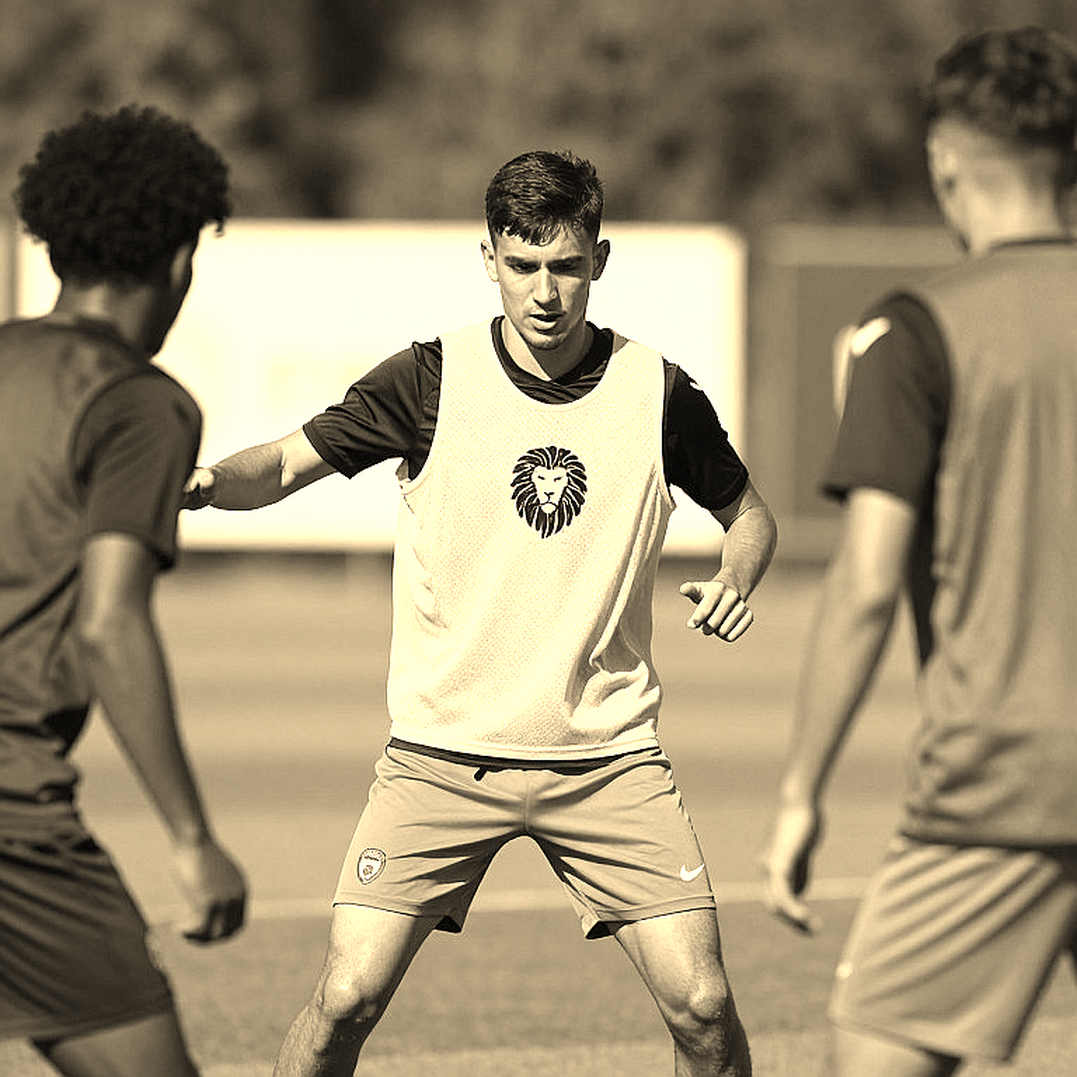
A 1.90m forward born in 2026, contracted to Ho Chi Minh City Police FC, carrying Vietnamese and English heritage — and he was pushed wide, not because he lacks central ability, but because the central role was already occupied by Xuan Son. The right-wing deployment was a calculated choice, not a throwaway experiment.
This leads to a tactical consequence I want to state plainly: Xuan Son's injury does not remove a striker. It removes the reference axis around which every other attacking piece was positioned.
Picture Vietnam's attack as an umbrella. Xuan Son is the shaft. When the shaft breaks, every rib shifts — including the ones that still look intact. Minh Hoang played wide not because he is a winger. He played wide because he was displaced from his natural role by someone else. That someone is now gone.
On attribute profile, Minh Hoang fits a central number 9: pace, technique, physical duel strength, hold-up play, finishing, plus a 1.90m frame with nimble movement and a deft touch. On paper, that is a proper centre forward.
But I will not sell my readers free confidence. Look at the sample: one national-team appearance, plus half a club season. That is the entire evidential base for claiming he can play centrally. Nobody can validate a 19-year-old against Thailand using half a season of football.
The plausible move: two prongs instead of one anchor
The most sensible structural adjustment is a two-pronged front — Minh Hoang and Dinh Bac sharing goalscoring responsibility. This is a bigger change than many assume. It is not just a personnel swap. It is a change in how the team builds.
In a single-anchor model, midfield looks to play into the centre so the striker can hold up and open the flanks. In a mobile two-forward model, midfield must play shorter and more penetratively, and the two forwards must rotate continuously. That is a qualitative shift in build-up philosophy, not a like-for-like substitution.
Based on my experience tracking matches in Southeast Asia, teams that change their attacking structure within three days usually choose the safe option: keep the system, slot the new man into the old role, accept the quality drop. Shifting fully to a two-forward shape in that window is rare at national-team level, because players need time to learn each other's movement patterns.
So the real question is not "Can Minh Hoang play centre forward?" The real question is: if he plays centrally, who makes the wide run that produced the Philippines goal? If Dinh Bac or another wide player cannot replicate that run, Vietnam loses both the centre and the flank.
And there is a data blind spot I must be honest about: the reports provide no xG, no PPDA, no possession share. Without those, no one can quantify Xuan Son's true impact. We can reason structurally; we cannot conclude numerically. When I have no data, I say I have no data.
Pressure and expectation: the section I always add
After the 2026 World Cup, I added a permanent section to every analysis of mine, titled "pressure and expectation." People laughed at me for asking Mbappe about emotions; then all of France wept with happiness. I do not write dry tactics, because fans need to understand a player's heart before discussing a formation.
With Minh Hoang, this pressure is extremely concrete. A 19-year-old has just been publicly cast as the replacement for the team's most important attacker. He has never played centre forward at senior international level. Vietnamese fans love their national team fiercely, and that love generates the region's heaviest pressure.
On Xuan Son's side, his public messaging toward teammates has been encouraging. This is an important dressing-room cultural signal: an injured star leaving mid-tournament can destabilise morale. Xuan Son did the opposite. He left supporting the team, not abandoned by it.
And coach Kim Sang Sik agreed to let Xuan Son return to Vietnam for treatment. That is a player-welfare decision, and I rate it highly. Letting an injured player leave camp for specialist treatment, rather than keeping him in the squad for media reasons, is good management.
The personnel issue: from naturalised to domestically produced
There is a structural angle here that I find most notable, and it extends beyond one match.
Xuan Son is a naturalised striker, contracted to Thep Xanh Nam Dinh. Williams Minh Hoang is a domestically developed product, contracted to HCMC Police FC, carrying Vietnamese and English heritage, born in 2026.
That transfer window was not merely a purchase; it was a crack in an entire footballing foundation. I use that image to say something else: Minh Hoang's story is a generational handover signal in Vietnam's attack — from a naturalised anchor to a domestically produced player with foreign roots. It is a structural signal about how a football nation builds future squads.
If it succeeds, it opens a new recruitment direction. If it fails, it does not prove domestic products are inadequate. It only proves that a 19-year-old was placed into a role needing three years of preparation, in a match needing three weeks of rehearsal.
The contrarian angle: where I could be wrong
First, the injury is described as a hamstring problem. I must be explicit: widely circulated public records associate Xuan Son with a more serious lower-leg episode at a different time. The two accounts cannot both be contemporaneous. I draw no conclusion about which is correct — I only demand source verification. Without data, I never publish; when data is ambiguous, I say so.
Second, the competition naming and venue also need verification. A FIFA-branded label on a Southeast Asian regional tournament, and an Indonesian stadium cited as the venue for Vietnam versus the Philippines, while Xuan Son's examinations also took place in Indonesia. A centralised format is atypical for the region's championship, usually played home and away. This is a data-integrity issue, not a rule breach. But it is enough to lower my confidence in every related claim.
Third — and most importantly — I may have underestimated Vietnam's adaptability. My assumption is that losing Xuan Son significantly reduces chance creation. But if Vietnam's midfield is better at short build-up than I believe, a two-forward shape could free space for technical players. I have no evidence to assert that. I also have no evidence to deny it.
Fourth, the opponent is not a fixed variable. Thailand presses better and is physically stronger than the Philippines clearly. But Thailand will also have little time to prepare against a Vietnam front line it has never seen. That is two-way uncertainty that data cannot resolve.
Fifth, recurrence risk. Xuan Son initially continued playing after the foul. Continuing after a hamstring injury raises recurrence risk. If it recurs after his return, a broader debate about mid-match injury management will emerge. I raise this as a warning, not an accusation.
The takeaway
I do not write to assign blame. I write so readers see concrete action after every statement. In 2026, I learned to hear football with my heart when the stadiums had no voices left. Since then, every analysis of mine must include a proposed solution.
Vietnam's solution sits in three layers. Structure: move to a Minh Hoang and Dinh Bac pairing, sharing scoring responsibility rather than concentrating it. Communication: frame Minh Hoang as a long-term option, not an immediate saviour — this prevents the hype-to-kill cycle that no 19-year-old deserves. Medical: Xuan Son returns only when fully rehabilitated, not when the team needs him.
At club level, two parties are directly implicated. Thep Xanh Nam Dinh absorbs short-term sporting cost from missing its striker in V.League fixtures, but limited long-term financial damage if the hamstring heals cleanly. HCMC Police FC suddenly holds an appreciating asset. A 19-year-old capped internationally with a goal contribution is a short-term valuation trigger. And in the Southeast Asian market, regional attention can arrive far faster than a normal development curve.
My verifiable prediction: Vietnam will face Thailand with a two-pronged attack, and the question is not whether Minh Hoang plays well, but whether the midfield can supply him at the right rhythm. If Minh Hoang plays centrally and Dinh Bac runs wide, that is a genuine structural shift. If Minh Hoang stays wide and someone else plays centre forward, the team has chosen the safe option, and its attacking output will depend on low-probability events like the Philippines goal.
Those two scenarios lead to two very different futures for the rest of the tournament. Both can be verified simply by looking at the starting lineup. I will be watching.
Facts requiring verification
- Tournament label and format: a FIFA-branded designation for a Southeast Asian regional competition.
- Venue: an Indonesian stadium for Vietnam versus the Philippines.
- Injury type: hamstring versus previously circulated record of a lower-leg episode.
- Williams Minh Hoang's sample: one senior international cap, half a club season.
- No xG, PPDA, or possession data to quantify tactical impact.
This analysis is based on publicly available information and text-deconstruction results, provided for sports information reference only.