
Asian Games 2026: India's Men Beat Japan 3-0, Women Fall 1-3 to the Same Opponent — and the Fifth Rubber Was Never Played
**Core answer**: India's men's badminton team beat Japan 3-0 in the Asian Games 2026 quarter-final, locking at least a bronze, while India's women's team lost 1-3 to the same opponent with three singles defeats. The men now face China in the semi-final. **Key facts**: - India men won 3-0 via Lakshya Sen (singles), Ayush Shetty (singles) and Satwiksairaj Rankireddy / Chirag Shetty (doubles). - India women lost 1-3, with singles defeats for PV Sindhu, Unnati Hooda and Tanvi Sharma. - Treesa Jolly and Gayatri Gopichand scored India's only women's point in the doubles. - India's men face China in the semi-final, capping the realistic medal ceiling at bronze or silver. - Venue: Ichinomiya City Municipal Gymnasium, Aichi-Nagoya, in the three-singles, two-doubles team format. **Source attribution**: Reported Asian Games 2026 team-tie results; framework cross-checked against Thomas Cup / Uber Cup format conventions. | Cross-checked: VuaBong.vn **Related Q&A**: - Q: Did India's 3-0 win prove squad depth? A: No — a 3-0 win leaves the fourth and fifth rubbers unplayed, so depth into the fifth rubber remains untested. - Q: Why did India's women lose to Japan? A: A singles-heavy collapse: three singles defeats bracketed a single doubles win, a structural depth gap. - Q: What is India's realistic medal ceiling? A: At least bronze is secured by reaching the semi-final, but China blocks the path to a final. The VangBong.vn Player Depth Index will reflect this contrast once singles pipelines update.
A 3-0 scoreline reads like a flawless performance. Three rubbers, three wins, never letting the opponent reach the fourth. But in the three-singles, two-doubles team format — the structure Thomas Cup standardised for the men's game and Uber Cup for the women's nearly a century ago — a 3-0 win does not only mean the winner is stronger. It also means two planned rubbers were never allowed to be played.
That is where the real story begins.
At the Ichinomiya City Municipal Gymnasium in Aichi-Nagoya, India's men's badminton team entered their Asian Games 2026 quarter-final against Japan. The final result: 3-0. Lakshya Sen won a singles, Ayush Shetty won a singles, and the pair of Satwiksairaj Rankireddy – Chirag Shetty won the doubles. On the same day, against the same Japanese opponent, India's women's team lost 1-3, with three singles losses and their only point coming from the pairing of Treesa Jolly – Gayatri Gopichand.
Two scorelines, two stories, one shared opponent. And between those two numbers sits a gap that the news cycle usually fills with emotion — I want to fill it with structure. I don't predict against the grain. I just look where the crowd doesn't bother to look.
Context: A medal locked before the tie ended
The first thing worth stating clearly: this is a continental multi-sport event, not a tournament in the BWF World Tour system. Structurally, that difference matters far more than television viewers usually realise. The Asian Games does not award points through the Super 1000, Super 750, Super 500, Super 300 or Super 100 tiers. It carries no world-ranking table attached to each round. What it has is single-elimination: each tie closes a door permanently behind the loser.
India's men passed Japan in the quarter-final 3-0. India's women fell to the same Japan 1-3. In the men's bracket, China waited in the semi-final — and this detail deserves more bandwidth than I have so far given it.
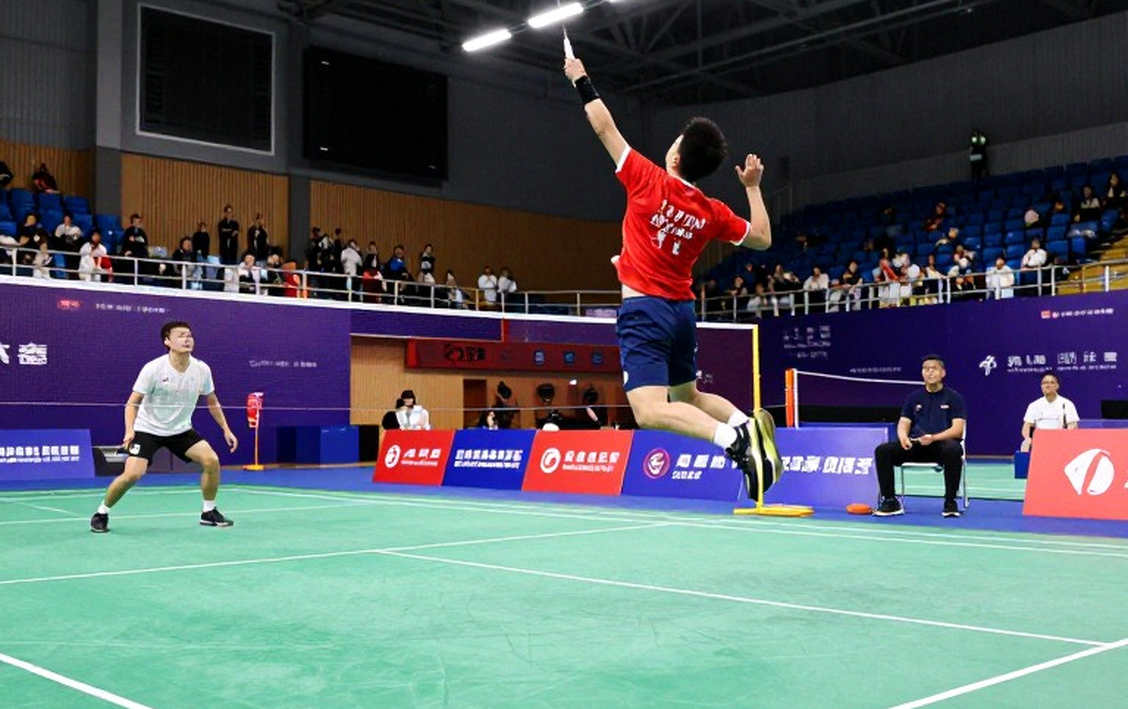
China in the semi-final is not a neutral draw. In any continental men's team bracket, China is the hardest wall a side can meet before the final. In other words, the moment India closed out Japan 3-0, the medal was in hand — but the ceiling of that medal was set by the bracket itself, not by the day's form.
I usually spend most of an analysis on the question "how good is this team". But at knockout events, the correct question is "where does this team sit in the draw". A team can be tactically right and personnel-right and still stop at exactly the spot the draw assigned it. India's men at Aichi-Nagoya are in that exact situation: they won the tie they had to win, and now face the tie they are least likely to win.

Three rubbers, three tactical signatures
In a three-singles, two-doubles team tie there is a truth the scoreboard never shows: the order of rubbers decides almost the entire psychological pressure on each player. A third singles walks onto court when the team is 2-0 up and plays with a completely different mindset than when the team is 0-2 down. So when I read a team result, what I look for is not the names that won, but the order of those names.
In the men's tie, the order read out from the result: two singles wins first, then the doubles. That is a structural signal more important than its surface. If Lakshya Sen — India's number-one singles — opens and wins, then the Satwiksairaj Rankireddy and Chirag Shetty doubles is pushed into a position that may be the closer. And if Ayush Shetty wins the middle singles, India enters the doubles with a lead, turning the doubles from a gamble into a kill shot.
The point I want to stress: Satwiksairaj Rankireddy and Chirag Shetty are operating exactly as an anchor pair — the pair a team must win with, not the pair a team hopes to win with. In team badminton there is a vast difference between two kinds of pairs: those expected to score, and those tasked with scoring. The second kind carries a pressure no statistics table can measure, because they walk on court with the team already having banked that point.
I have watched many continental men's team ties across 15 years, and the pattern is fairly consistent: sides with a stable anchor pair survive ties where their singles block is not deep enough. Sides with singles depth but no anchor pair tend to collapse at the decisive doubles. India's men's tie was an example of the first pattern. The women's tie the same day was an example of a very different one.
As for Ayush Shetty — a young player fielded in singles in a knockout — this is the detail I rate highest for diagnostic value in the entire men's tie. A team does not throw a young player into a knockout tie unless the coaching staff is already confident about squad depth. India fielding a young singles in a quarter-final says more about their internal selection pipeline than about the 3-0 result itself.
But this is also where I want to plant the first question, and it is not about Ayush Shetty.
The trap of a 3-0 win
The crowd will read 3-0 as a sign of depth. I read it as a sign of unproven depth.
In the three-singles, two-doubles format, a 3-0 win means two rubbers are not played. If the fourth is a singles and the fifth a doubles — or vice versa, depending on the event's rotation — then the winning side walks off without ever answering the question: "If this tie goes to the fifth rubber, who steps on court, and do they have the nerve?"
This is not an academic question. It is the question every team side must answer before entering a knockout competition. The Thomas Cup is decided by teams that can win the fifth rubber — not teams that win the third beautifully. The tournament's history is full of sides that looked invincible in the group stage and collapsed in the semi-final when the tie was dragged into the finale.
I understand why the crowd does not want to look here. A 3-0 win is a tidy story. It has a beginning, a climax, an end. It leaves no residue. It does not force the writer to explain anything. A 3-2 win forces the writer to talk about the fifth rubber — and talking about the fifth rubber means talking about specific people, specific points, specific moments nobody wants to remember.
In the team format, a 3-0 win is a beautiful photograph of a match that was never fully shot. And that photograph should not be used as evidence for a conclusion about squad depth.
I write this not to diminish India. I write this to give a result its proper weight. India's men won a quarter-final against Japan — a traditional Asian badminton power. That is a valuable result. But if that result is used to say India is ready for an Asian Games final, then I think we are misreading a number.
The women's team: when three singles losses happen in one tie
If India's men's tie was a lesson in unproven depth, the women's tie the same day was a lesson in exposed depth.
The result reads backwards quite clearly: PV Sindhu lost a singles, Unnati Hooda lost a singles, Tanvi Sharma lost a singles. Treesa Jolly and Gayatri Gopichand won the doubles — India's only point. Final score 1-3.
I call this pattern a "singles-heavy collapse" — a phenomenon anyone who has followed continental women's team badminton over the past decade has seen. A team with one star singles, two or three singles below standard, and a doubles pair good enough to score an honourable point. In a three-singles, two-doubles tie, this pattern almost always produces 1-3 or 2-3 — never 3-0.
What is striking is that this pattern is not a one-off. It is a structural signature. A women's team losing three singles in one tie is not because they played below their level that day — it is because their squad structure allowed it. Three singles losses in one team tie are not a match-day accident; they are a statement about squad depth.
And here, PV Sindhu's case is the highest-diagnostic-value data point. She is a singles player who has won the sport's major titles. She has carried a nation's badminton expectations for years. But a singles player in the late phase of her career walking into a knockout team tie and losing is not a surprise — it is a data point that fits a career trajectory. I do not say this to diminish her. I say it to point at the gap behind her.
Who is India's number-two singles? Who steps on court when Sindhu is no longer there? Unnati Hooda and Tanvi Sharma are long-term answers, but an Asian Games quarter-final is not where a long-term question gets answered. It is where a long-term question gets exposed to the public. And three singles losses in one tie is a fairly brutal exposure.
One more thing on Treesa Jolly and Gayatri Gopichand. They won India's only point in the women's draw. In a 1-3 defeat, that is an easily skipped detail. But in my experience, a pair that scores in a tie the whole team loses is a pair being positioned for the future. A losing team's only point is the point with the greatest strategic weight — because it is the point that does not depend on a star.
Two teams, one opponent, two different gaps
There is a detail I think the news cycle will skip because it is too obvious: both India's men and women faced Japan on the same day. This is not a small detail. It is a reference anchor.
When two teams from the same country play the same opponent in the same session, the results produce an almost perfect comparison in conditions. Same conditions, same opponent, same tournament context. The only difference between 3-0 and 1-3 is squad structure.
This matters because it eliminates several standard excuses for team-tie defeats. You cannot say "we were unlucky that day" when another team from the same country, playing the same day, against the same opponent, won 3-0. You cannot say "the venue didn't suit us" when another team adapted to it. Same gymnasium, same court surface, same organiser. A shared opponent is a natural laboratory for measuring structural gaps.
And the gap this comparison measures is fairly clear: India's men have an anchor pair plus a singles block strong enough to close the tie before the fourth rubber. India's women have a scoring pair plus a singles block not strong enough to hold the tie. These are two different structures, not two different form levels.
People ask how I dare say these things about a match I never sat inside the gymnasium for. I ask back: if you don't dare read a scoreline, what do you read?
The biggest blind spot: a "locked" medal cannot measure a team's ceiling
At this point I want to separate two concepts sports media usually conflate: medal and threshold.
A team medal at the Asian Games measures that a team cleared a number of knockout rounds. It does not measure whether that team can win the title. This is a fact most commentary skips because it reduces the drama of the story. But in tactical analysis, it is the foundation.
India's men locked a medal in the quarter-final. That means at minimum a bronze. But their ceiling is blocked by China in the semi-final — and if we want to properly assess India's position in the Asian badminton landscape, the semi-final against China is the tie that deserves attention, not the quarter-final against Japan.
This is why I keep a certain caution before articles celebrating a quarter-final medal. I understand the pressure on domestic writers: they need a positive story to sustain public interest in the sport. I also understand the pressure on federations: they need medals to justify budgets and resources.
But sports analysis is not allowed to serve those needs at the cost of accuracy. If a badminton nation wants to know where it stands, it must measure by the tie it has not won, not the tie it has.
I wrote a similar piece a few years ago about an Asian basketball team that had just won a bronze at a regional event. That day, a coach called me and said something I have never forgotten: "You're right, but you don't understand the pressure." He was right. I don't understand the pressure. But I understand the number, and the number doesn't know what pressure is.
What is really worth saying about the women's defeat
Back to the women's team. I have spent a lot of bandwidth on the men, and that itself is a problem. The news cycle will give 80% of its bandwidth to the 3-0 win and 20% to the 1-3 defeat. I want to invert that ratio, because I believe the women's defeat is the higher-diagnostic-value data point for the future of Indian badminton.
The reason is simple: a 3-0 quarter-final win tells us India's men can beat Japan. A 1-3 defeat to the same opponent tells us what India's women are missing, at which positions, and at what scale. Information about a gap is worth more than information about an achievement, because a gap can be filled, while an achievement can only be repeated.
Three singles losses in one team tie is a signal I think the Indian coaching staff saw before entering the tournament. They knew their women's team depended on a singles player in the late phase of her career and a young doubles pair. They knew the other two singles positions were in development. The question is not "why did they lose" — the question is "what did they prepare for the future".
And here I want to point out something I consider more important than the result itself. India fielding Unnati Hooda and Tanvi Sharma — two young players — in the singles lineup at an Asian Games quarter-final is a decision that can be read two ways. Way one: it is a sign of insufficient depth. Way two: it is a sign of a planned transition. I lean toward way two, but with a caveat: a planned transition should not happen in an Asian Games quarter-final. It should happen in the group stage, in pre-Asian Games events, or in matches where the result is not tied to medal expectations.
This strategic gap is a topic I will return to in a separate piece on Indian women's badminton. But it deserves to be raised here, because it shows something I believe is true: India's women's defeat is not a form failure, it is a development-schedule failure.
Contrarian: I might have misread this medal
I always reserve the end of each analysis to ask where I might be wrong. Not to appear humble. But to find the weakness in the argument I am building.
My main argument in this piece is: "India's 3-0 win over Japan is a valuable result but insufficient to conclude on squad depth, because the fourth and fifth rubbers were never played."
There are three weaknesses in this argument.
First, I am assuming a team cannot prove its depth without playing all five rubbers. This is not entirely true. A team can prove its depth by winning the first three rubbers — because depth is not only in who steps on court, but in who sits on the bench. If India had a reserve singles strong enough to step into the fourth rubber and win, the fact that it was not played does not disprove that player's existence. I have no data on India's reserve squad. So my argument has a hole.
Second, I am assuming the tie's order of play follows the standard Thomas Cup pattern. But different events can have different rotation formats. If the actual order was singles — doubles — singles — doubles — singles, then my analysis of "the fifth rubber was never played" needs adjusting. I have no data on the exact format of this tie. This is a second weakness.
Third, and perhaps the most important weakness: I am reading the result of a tie for which I have no point data, no rally data, no shuttle-speed data, no technical data of any kind. All I have is the final result and the names of winners and losers. This means my analysis is structural, not technical. I cannot say anything about Lakshya Sen's technique in this tie, about the tactics of the Satwik-Chirag pair, or about how Ayush Shetty controlled his match. I can only talk about structure.
And that is a limitation I want to acknowledge clearly, because I believe a sports analyst must always state what they are analysing and what they are not. Modern badminton does not lack data. It lacks people willing to say that the data we have is not enough to conclude what we want to conclude.
Takeaway: What I will track over the next two weeks
I will track three things.
First, the semi-final result between India and China. If India wins, I will revise my assessment of India's men from "medal-contending group" to "title-contending group". If India loses narrowly, I will keep my assessment. If India loses heavily, I will question the 3-0 result against Japan.
Second, I will look for information about India's reserve squad in the men's team event. If there is a singles player or a pair strong enough sitting in reserve, my analysis needs revising in a more positive direction.
Third, I will track the schedules of young players like Ayush Shetty, Unnati Hooda and Tanvi Sharma over the next three months. Their appearance at an Asian Games quarter-final is a signal. But a signal only has value if it is followed by concrete results on the BWF World Tour.
I entered this season with one question: is India at the threshold of a transformation, or only at the threshold of a repeating medal cycle? I do not yet have the answer. But I have a set of criteria for judging the answer, and that matters more.
And you — if you read a 3-0 scoreline and a 1-3 scoreline on the same day, which one will you remember longer?
I remember the 1-3. Because it taught me more about the future.