
Amiri Scrapes the Penalty Spot Before Kevin Diks' Kick: Hamann Demands a Ban While Gladbach Sink at the Bottom
Câu trả lời cốt lõi: Nadiem Amiri (Mainz 05, 29 tuổi) dùng gót giày xới mặt cỏ quanh chấm phạt đền trước cú sút của Kevin Diks (Borussia Mönchengladbach); trọng tài Robert Hartmann không phát hiện. VAR không thể can thiệp vì đây chỉ là lỗi ở mức thẻ vàng, nhưng cơ quan kỷ luật của Liên đoàn bóng đá Đức có thể xử sau trận bằng băng ghi hình. Dữ kiện chính: - Nadiem Amiri, 29 tuổi, tiền vệ Mainz 05, xới mặt cỏ chấm phạt đền khi Mainz 05 dẫn 2-1. - Kevin Diks sút hỏng quả phạt đền đó; trọng tài Robert Hartmann và tổ trọng tài không phát hiện hành vi. - Didi Hamann trên Sky gọi hành vi là phi thể thao trắng trợn và đòi treo giò một trận. - Mainz 05 thắng trận; Borussia Mönchengladbach đứng cuối bảng với 0 điểm sau 4 vòng, huấn luyện viên Eugen Polanski bị sa thải sau vòng 3. - Amiri có tên trong danh sách triệu tập đội tuyển Đức dưới thời Jürgen Klopp, hai trận quốc tế đang chờ. Nguồn: Goal.com, tổng hợp phát biểu của Didi Hamann trên Sky; tài liệu gốc không ghi ngày công bố. Các dữ kiện về bảng xếp hạng Bundesliga và nhân sự ban huấn luyện Gladbach cần được đối chiếu lại với công bố chính thức của giải và liên đoàn trước khi sử dụng. Hỏi đáp liên quan: Hỏi: Amiri có bị treo giò không? Đáp: Khả năng cao nhất là án tiền phạt; treo giò chỉ nằm ở kịch bản nặng với xác suất thấp. Hỏi: Vì sao VAR không xử lý tình huống này? Đáp: Nghị định thư VAR chỉ cho phép can thiệp với lỗi thẻ đỏ, quyết định phạt đền, bàn thắng trực tiếp và nhầm lẫn danh tính. Hỏi: Điều gì đáng theo dõi hơn vụ chấm phạt đền? Đáp: Cuộc khủng hoảng của Borussia Mönchengladbach, đội đứng cuối bảng với 0 điểm sau bốn vòng.
When Mainz 05 led 2-1 and referee Robert Hartmann pointed to the penalty spot for Borussia Mönchengladbach, Kevin Diks placed the ball on the turf, stepped back and took a long breath. Nobody in the officiating team noticed that seconds earlier Nadiem Amiri had walked past the white mark, bent down and scraped the grass around it with his studs. Diks ran up, struck the ball, and missed. Play continued as though nothing had happened.
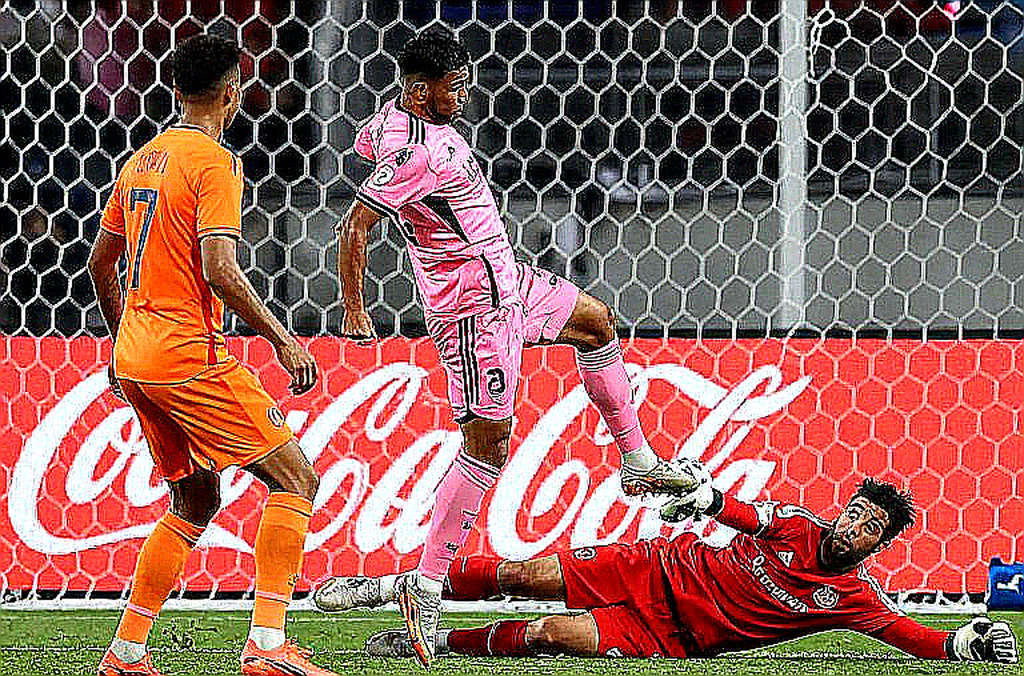
Only when the footage was replayed in slow motion did the 29-year-old midfielder's action emerge in full. On Sky, former international Didi Hamann called it "grossly unsporting behaviour", said Amiri had "far overstepped a line", and delivered his heaviest line: "I would take him out of circulation." He also raised the image of children watching.
A two-second act. A week of argument. And behind all of it, a story nobody picked up: the team that lost that night is sinking faster than anyone expected.
Having sat through the replay of this match several times at different speeds, I found the most telling detail was not the studs. It was the empty stretch of time between Diks placing the ball and Diks beginning his run-up.
The incident needs to be placed in its proper frame. The match produced seven goals. Mainz 05 scored twice in the closing phase, immediately after being pegged back. Isac Lidberg, a new signing, equalised for the home side, and the rotational options left their mark inside the box. Borussia Mönchengladbach left with a fourth defeat in four matchdays, 0 points from 12, bottom of the Bundesliga table.
That is a far bigger story than a boot heel.
Gladbach are five-time German champions. They dismissed head coach Eugen Polanski after only the third matchday, promoted Jan-Moritz Lichte to an interim role, while Alexander Blessin is being reported as the incoming successor. Hamburger SV and 1. FC Köln, two more storied names, sit in the same lower band. When the bottom of the table is that dense with big brands, the reputational cost of one relegation place rises exponentially.
For Amiri, the personal context is no lighter. He has turned 29, sits at the back end of his peak years, and has just been named in the first squad of the Jürgen Klopp era with Germany, with two internationals ahead. The timing of the incident could hardly be worse.
Technically, this is not a tactical story. There is no formation, no pressing data, no expected-goals figure anywhere in the source material.
Amiri's action belongs to the gamesmanship category: behaviour short of a clear foul, designed to gain a psychological or practical edge. Under the IFAB Laws of the Game it falls into Law 12, unsporting behaviour, a cautionable offence. Law 14 requires the penalty mark to be clearly identifiable with the ball stationary on it; had the referee spotted the damage, the correct remedy would have been to restore the mark and caution the offender before the kick was taken.
The decisive legal point is that VAR cannot intervene. The VAR protocol permits intervention in four categories only: red-card offences, penalty or no-penalty decisions, direct goal awards, and mistaken identity. A cautionable offence sits outside that list. Referee Hartmann's team failing to spot Amiri's act is therefore rule-consistent rather than a technology failure.
At the same time, the doctrine that a referee's on-field factual ruling is final does not shield acts the referee never observed. That is the familiar route: Germany's football association disciplinary court can open a case after the match on video evidence, exactly as it has done with spitting, simulation and off-ball misconduct.
So what sanction is actually coming?
Worst case: a case is opened, a two-to-three-match suspension plus a fine is imposed, with the image-of-the-game argument treated as aggravating. That outcome sits at low-to-moderate probability, because the act is gamesmanship rather than violence.
Central case: a financial penalty, from the club, the federation, or both, with no suspension or only a token one. This is the most likely band, reinforced by the source's own caution, which labels any causal link between the damaged spot and Diks' miss as "pure speculation".
Lightest case: no case is opened at all and the matter is closed internally at Mainz.
Hamann's call for a one-match ban is a pundit's threshold, not a regulator's threshold.
Then there is Gladbach. This is the part that should worry people.
Conceding twice shortly before full time, right after equalising, is a textbook marker of a group with broken in-game leadership: a coach sacked after three matchdays, an interim without enough time, a successor not yet in the chair. Four matches is far too small a sample for system-level conclusions, but the direction is unmistakable: zero points, bottom of the table, and a squad already accustomed to mid-season coaching changes.
Behind the table lies a financial layer that rarely gets mentioned. Relegation means losing a meaningful slice of the Bundesliga's central distribution, plus matchday and commercial revenue. The source offers no data to quantify it, so I stop at identifying the direction of the risk rather than sketching estimates with no foundation.
For Amiri there is a different calculation. At 29 he is at the back end of his peak and entering the depreciation phase of the transfer-market age curve. A reputational event landing at that exact moment creates double depreciation: residual resale value was already limited, and it is now discounted further by a non-sporting factor.
This is where I want to be blunt.
Scraping the grass around the penalty spot is not Amiri's invention. It exists in every league, at every level, from youth pitches to matches broadcast to hundreds of millions. Goalkeepers dancing on the line, defenders standing deliberately in the shooter's eyeline, strikers waiting long enough to cool an opponent's nerve: all of it lives in the same ecosystem. What is new here is that a camera caught it and a pundit chose it as the topic of the evening.
I had a microphone cut on live television at 53. That taught me something about this trade: most moral arguments in football are generated by the needs of the debate format more than by the event itself. Losing one microphone taught me I could build an entire sound desk out of data. Here, Hamann's voice is that sound desk, and it did not need a missed penalty to start ringing.
Another paradox sits at Gladbach. The interim-then-permanent sequence the board is following is, structurally, the more orderly of the available paths: a short bridge to prevent an interim from accumulating irreversible failure. The fact that a permanent candidate is already being named is a stability signal, not a chaos signal. Gladbach's real risk is not the coaching chair; it is that the club has grown used to instability.
And do not assign causality to Diks' miss. The original source itself labels that hypothesis pure speculation. At my age I no longer run faster, but I know which way the wind blows, and this wind is blowing at one individual while a football club is the thing actually on fire.
People filter transfer news; I filter the sweat of the market too. The Mainz case will be decided in the coming days by a federation statement, or by its silence. But what matters over the next six matchdays is not the penalty spot. It is whether Blessin can rebuild a spine for the bottom club, and whether Amiri takes the field in either international. A polymath in the arena is someone who knows when to stop analysing and start feeling, and here the first feeling is simple: a scraped penalty spot can be repaired, a scraped season cannot.