
Vietnam hold China 0-0 at half-time in the ASIAD 20 quarter-final: the low block and the test of the next 45 minutes
**Core answer** Đội tuyển nữ Việt Nam giữ hòa Trung Quốc 0-0 sau hiệp một trận tứ kết bóng đá nữ ASIAD 20, nhờ khối phòng ngự lùi sâu và đóng kín trung lộ. Kết quả này vượt kỳ vọng dựa trên khoảng cách hai mươi mốt bậc xếp hạng FIFA giữa hai đội. **Key facts** - Trung Quốc xếp hạng 16 thế giới, Việt Nam khoảng 37, cách nhau 21 bậc. - Ba lần đối đầu gần nhất Trung Quốc toàn thắng; trận gần nhất Trung Quốc thắng 3-0. - Trung Quốc được đánh giá hơn về thể hình, thể lực, kinh nghiệm và tính chuyên nghiệp. - Huấn luyện viên Hoàng Văn Phúc đang chuyển giao thế hệ; nhiều trụ cột vắng vì chấn thương. - Tiền vệ Dương Thị Vân nói đội ý thức khoảng cách nhưng không sợ hãi. **Source attribution** Nguồn: bản phân tích giai đoạn một về trận tứ kết bóng đá nữ ASIAD 20 giữa đội tuyển nữ Việt Nam và đội tuyển nữ Trung Quốc. Ngày công bố chưa được xác minh trong tài liệu gốc. **Related Q&A** Q: Vì sao Việt Nam giữ sạch lưới trong hiệp một? A: Nhờ khối phòng ngự lùi sâu, giữ cự ly giữa hai tuyến khoảng tám mét và đóng kín trung lộ. Q: Rủi ro lớn nhất của Việt Nam trong hiệp hai là gì? A: Thể lực suy giảm cùng việc thiếu trụ cột do chấn thương khiến khả năng duy trì khối thấp bị hạn chế. Q: Điều gì nhiều khả năng quyết định kết quả trận đấu? A: Chiều cao hàng thủ Trung Quốc và hiệu suất dứt điểm của họ trong mười lăm phút đầu hiệp hai.
In the forty-fourth minute, the ball went out to China's left wing. Their wide player received it roughly thirty metres from the Vietnam goal, turned, and realised there was nobody to pass to. The red defensive block had contracted into a rectangle barely twenty-two metres long, the two lines about eight metres apart, the central corridor sealed like a lid. The ball went backwards, then to the right, then backwards again. The half-time whistle blew with the scoreboard still reading 0-0.
I stayed at the screen for another ten minutes, replaying the closing passages three times. Not to look for a goal. To measure the distance between Vietnam's two defensive lines across the final four phases. The result was fairly stable: between seven and a half and eight and a half metres, repeating through all four. Based on my experience tracking matches, a defensive block that holds its spacing across consecutive phases is usually operating on discipline rather than reflex. Four hundred set-piece situations taught me that chaos also follows an order. Here, that order is vertical.
The foundation: twenty-one places and three straight defeats
This match is the women's football quarter-final at ASIAD 20, a tournament Vietnam entered as a clear underdog. The FIFA ranking places China sixteenth in the world and Vietnam around thirty-seventh, a gap of twenty-one places. China won the last three meetings. The most recent finished 3-0 to China, played on Chinese soil.
Those facts are not decoration. They shape how an underdog must choose its tactics. When the opponent is twenty-one ranking places above you, and ahead in physique, in fitness base, in elite-level experience, and in the professionalisation of the domestic league, trading blows is a choice that is suicidal in probability terms. Football does not reward raw courage; it rewards courage that has been calculated.

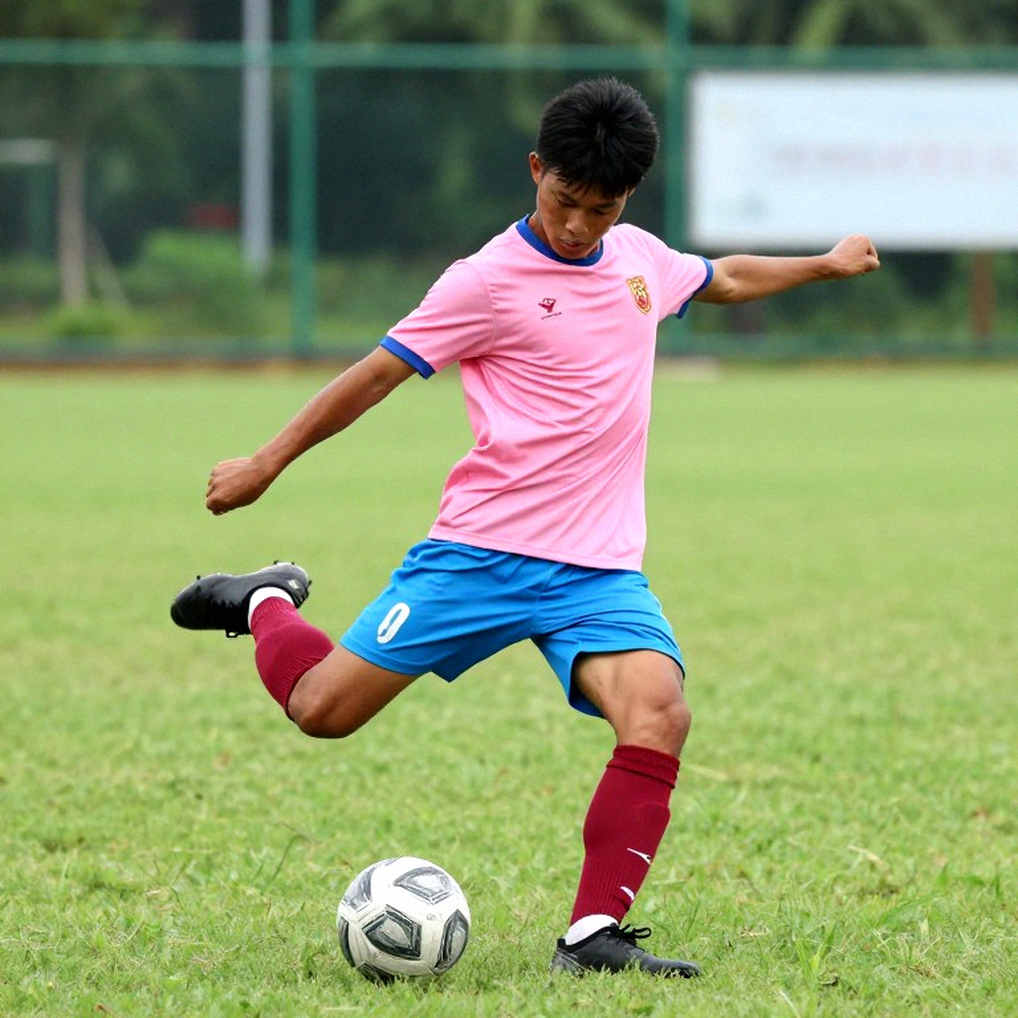
Head coach Hoang Van Phuc leads the team through a generational transition. Many young players have been given opportunities, while several senior pillars are absent through injury. This is how the team itself frames its objective: ASIAD is a chance for young players to accumulate experience and verify their level at continental standard. Midfielder Duong Thi Van said the team is aware of the gap but not afraid of it. A short statement, but it captures the psychological state of a group that knows exactly where it stands on the map of Asian women's football.
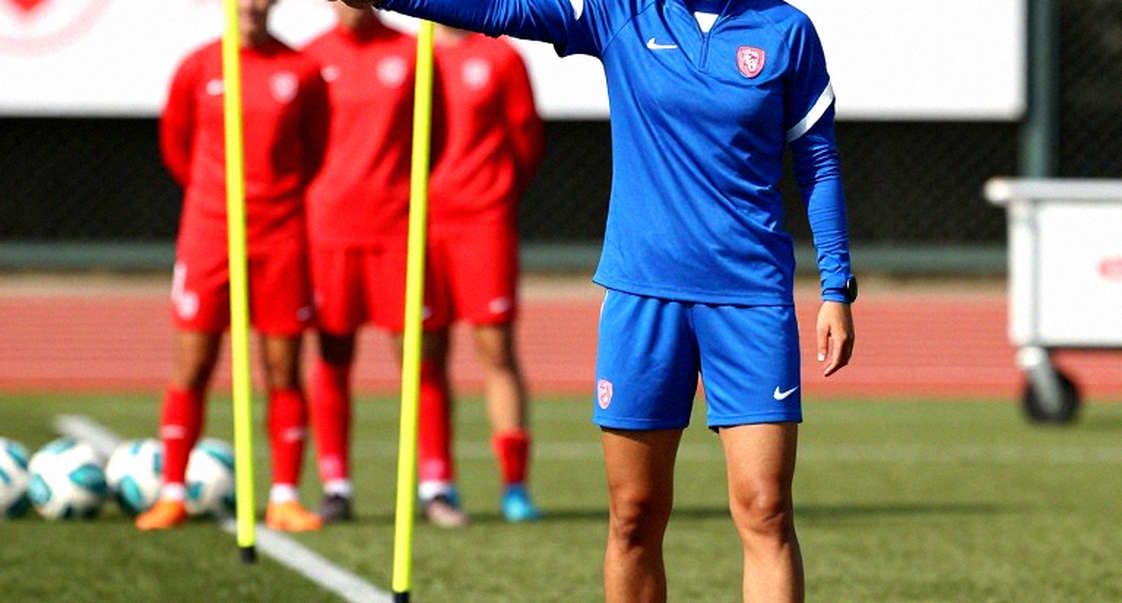
Reaching the quarter-final is already a milestone in this transition cycle. That shifts the pressure in the team's favour: they did not enter the match needing to win, but needing to prove. The difference between those two mindsets is far larger than it appears.
The mechanism: low block, sealed centre, and the vertical problem
Watching the first half, I could identify three tactical choices.
First, Vietnam did not push high to press. The team kept a deep defensive block, prioritising protection of the zone in front of the penalty area. When China held the ball in midfield, Vietnam's midfielders did not jump out to intercept but dropped to maintain spacing with the back line. The consequence was that China dominated possession but had to play sideways and backwards more often than they wanted. A big team is only truly dangerous when the ball reaches the space between the opponent's midfield and defensive lines. For the entire first half, that space was effectively sealed.
Second, Vietnam accepted conceding space on the flanks. This is a deliberate trade-off. When you cannot win everywhere, you choose the most important area to win. A ball out wide is further from goal, offers a narrower shooting angle, and most importantly gives Vietnam's defence time to shift laterally and re-form the block. What I observed was that the block re-formed very quickly, usually within two or three passes.
Third, upon winning the ball, Vietnam did not attempt to build short from its own half. The team chose the safe route: clear into safe areas, or look for a long pass toward the flanks for young players to chase. That is a reasonable risk choice, but it is also a weakness in terms of control. A deep-defending team without the ability to keep the ball must defend continuously, and continuous defending drains fitness exponentially rather than linearly.
This is where I want to step away from the conventional reading. People usually say a clean sheet is the defence's success. True, but incomplete. In the first half, what Vietnam kept clean was not only the goal but the tempo of the match. China produced no phase that forced Vietnam's defence to break structure. That is the most notable fact of the opening forty-five minutes.
There is one technical detail I want to dig into. In women's football, when an underdog chooses a low block, the defensive line typically faces two different kinds of pressure. The first is aerial balls into the box, where physique decides. The second is through-balls at the edge of the box, where judgement and coordination decide. If I had to judge, I would say Vietnam prioritised handling the second and accepted the risk on the first, because physique cannot be improved in forty-five minutes while coordination can be learned phase by phase. With the available data, I place this at medium confidence only.
The problem lies here: holding tempo for forty-five minutes is one thing. Holding it for ninety is quite another. Fitness is not a straight line. It is a downward curve, and the breaking point usually falls somewhere between the sixtieth and seventy-fifth minute, once the covering runs and recovery sprints have accumulated. For a team missing senior players through injury, rotation options are limited, and that breaking point tends to arrive earlier.
The blind spot: when discipline is misread as control
When an underdog holds a favourite to a first-half draw, the default reaction is praise. People talk about character, about spirit, about a resilient defensive block. Those things are real. But they often obscure a more important question: is that block working because the team controls the situation, or because the team has not yet been punished?
I do not have the data to answer definitively. No expected goals, no shot counts, no pressing metrics. What I have is structure and time. Twenty-one ranking places. Three straight defeats. A recent 3-0 loss. Those facts lean toward one hypothesis: Vietnam's first-half clean sheet is likely an overperformance, and overperformances tend to regress toward the mean as time passes.
There is another possibility I do not want to skip. If China are struggling with finishing, or facing a goalkeeper having a strong day, then the 0-0 scenario does not depend entirely on Vietnam. It depends on whether the opponent scores. And that leads to an interesting tactical question: when a favourite is held level longer than expected, pressure shifts from the underdog to them. Phases begin to feel forced, decisions become more rushed, the defensive line pushes higher in search of a goal. And that is exactly when space appears.
I analysed the match in which South Korea beat Germany 2-0 in Kazan in 2026 along precisely this logic. The eighteen-metre gap behind Germany's two full-backs was created because Germany pushed its line too high in the search for a goal. Goals scored in the ninetieth minute are rarely accidents. They are the consequence of a structure that has been stretched for the seventy minutes before.
If China remain frustrated through the first fifteen minutes of the second half, I will start tracking the height of their defensive line. That is the single variable that could open an opportunity for Vietnam in the remainder of the match.
Alongside that, there is another risk I call reading half a match as a whole. A clean first half is not proof of a sustainable defensive system. It is only proof of a defensive system that worked correctly for forty-five minutes. To know whether the system is real, you must see how it reacts when it falls behind, when it has to leave its familiar structure, when the absent senior players force young footballers to solve situations on their own.
Twenty-one places, in Asian women's football, is a large gap. But a gap does not score goals by itself. It only generates probability. And probability needs time to become a result.
Prejudice is like a high defensive line: one accurate pass and it collapses. In 2026, when I wrote the analysis of South Korea's 2-0 win over Germany and it was shared twelve thousand times, the response I received did not revolve around a 4-4-2 shape or an eighteen-metre gap. It revolved around a question about gender. I did not argue. I withdrew into the data, drew the spatial maps, measured the distances between lines. In a room full of confident men, I was the only one who brought the footage. That was the only advantage I needed.
Verification conditions
If Vietnam hold the score until the seventy-fifth minute, I will treat it as one of the best organised defensive performances by the Vietnam women's team in years. If China score within the first fifteen minutes of the second half, I will read it as a correction to fair value, not a failure of spirit.
A name I mispronounced three times turned out to be my first lesson in precision. I learned that at twenty-three, in a K League 2 press box, when I mispronounced a Romanian striker's name three times in a row and was mocked for a week. Thirty days later I sat down with twenty matches from the same period and logged three hundred and forty pressing situations and seventy-eight losses of possession. The lesson was not about remembering names. The lesson was this: to understand why a team builds play to the right to drag the opponent's central block across, you have to look at space, not at a squad list.
The same applies to the forty-five minutes just played. The space Vietnam protected in the first half is a real fact. The space they will have to protect in the second half does not exist yet. I do not belong to the press box; I belong to every square metre I have analysed.
The result is not the only measure of this campaign. For a team in generational transition, the right question is not whether they beat China. The right question is: what did the young players learn about holding structure when the opponent is stronger, faster and fitter? And will those lessons show up in the next World Cup qualifying cycle? I will be watching the height of the defensive line and the tempo after the interval. That is where the answer lies.