
India Reach Asian Games 2026 Men's Team Badminton Quarter-Finals: Three Generations, a Data Vacuum and a Number That Cannot Exist
**Câu trả lời cốt lõi:** Ấn Độ thắng Bangladesh 3-0 ở vòng một đồng đội nam cầu lông Asian Games 2026 ngày 21 tháng 9 năm 2026 tại Nhà thi đấu Thành phố Ichinomiya, Nhật Bản, giành vé vào tứ kết. Cả ba trận đơn đều thắng sau hai ván; hai trận đôi không cần thi đấu. Kết quả phản ánh khoảng cách xếp hạng hơn 300 bậc, không phải chỉ dấu phong độ. **Dữ kiện chính:** - Tỷ số: Lakshya Sen 21-4, 21-12; Ayush Shetty 21-4, 21-13; Srikanth Kidambi 21-15, 21-9. - Ayman Ibn Jaman khoảng hạng 375 thế giới; Gourab Singha khoảng hạng 589 thế giới. - Bản tin ghi trận Kidambi dài chín phút, không khả thi với tối thiểu 66 pha cầu. - Đội hình Ấn Độ trải ba thế hệ: khoảng 25, 21 và 33 tuổi. - Asian Games không trao điểm xếp hạng BWF cho nội dung đồng đội. **Nguồn:** Bản tin kết quả Asian Games 2026, nội dung đồng đội nam cầu lông, ngày 21 tháng 9 năm 2026, Nhà thi đấu Thành phố Ichinomiya, Aichi-Nagoya. Số liệu chưa được đối chiếu với cổng kết quả chính thức của Hội đồng Olympic châu Á hoặc BWF. **Hỏi đáp liên quan:** Q: Ấn Độ sẽ gặp ai ở tứ kết đồng đội nam cầu lông Asian Games 2026? A: Đối thủ tứ kết chưa được công bố trong bản tin kết quả ngày 21 tháng 9 năm 2026. Q: Chiến thắng này có giúp các tay vợt Ấn Độ tăng điểm xếp hạng BWF không? A: Không, nội dung đồng đội tại Asian Games không nằm trong hệ thống tính điểm xếp hạng BWF World Tour. Q: Vì sao trận của Srikanth Kidambi đáng chú ý hơn hai trận còn lại? A: Ván đầu 21-15 cho thấy anh cần thời gian bắt nhịp với đối thủ lạ, và thời lượng chín phút được báo cáo không khả thi dưới luật rally 21 điểm.
On 21 September 2026, at the Ichinomiya City Municipal Gymnasium in Aichi Prefecture, Japan, India's men's badminton team opened their Asian Games 2026 men's team event campaign against Bangladesh. All three singles ties followed the same script: Lakshya Sen won 21-4, 21-12; Ayush Shetty won 21-4, 21-13; Srikanth Kidambi won 21-15, 21-9. India took the tie 3-0 and advanced to the quarter-finals without needing either doubles match.
The results report stated that Kidambi's match lasted "just nine minutes".
I read that line three times, then opened the spreadsheet.
A two-game match under the 21-point rally-scoring system, finishing 21-15 and 21-9, contains a minimum of 66 scored rallies: 36 in game one and 30 in game two. Sixty-six rallies in 540 seconds works out at 8.2 seconds per rally — and that figure does not yet deduct the mid-game interval at 11 points, the changeover between games, floor mopping and shuttle changes. No elite badminton match operates at that tempo. The realistic duration of a match with those scorelines sits between 25 and 35 minutes.
One wrong detail does not ruin an entire report. But the way it appeared — no sourcing, no cross-check, no verification — is a more worrying signal than the number itself.
Context: a tournament close to a world championship
The Asian Games 2026 are being held in Aichi-Nagoya. The men's team badminton event uses a five-match format: three singles and two doubles, with the first side to three matches winning the tie. This is a continental event under the Olympic Council of Asia, sitting outside the BWF World Tour system, and in principle it does not award BWF world ranking points for team events. Its value is medals, national prestige and the basis for sports budget allocation — not world ranking positions.
For Asian men's badminton, this is close to a scaled-down world championship. Indonesia, China, Japan, Korea, Malaysia, Chinese Taipei, Thailand and India are the nations and territories that have populated Thomas Cup semi-finals across multiple cycles. Denmark are absent, but in the men's team event that absence does not dilute the field.
That places the Bangladesh tie exactly where it belongs: the easiest possible first-round draw.
What the scoreboard says
| Tie | Indian player | Score | Opponent | Opponent ranking | |---|---|---|---|---| | Singles 1 | Lakshya Sen | 21-4, 21-12 | Ayman Ibn Jaman | approx. world No. 375 | | Singles 2 | Ayush Shetty | 21-4, 21-13 | Gourab Singha | approx. world No. 589 | | Singles 3 | Srikanth Kidambi | 21-15, 21-9 | Jumar Al-Amin | not stated in the report |
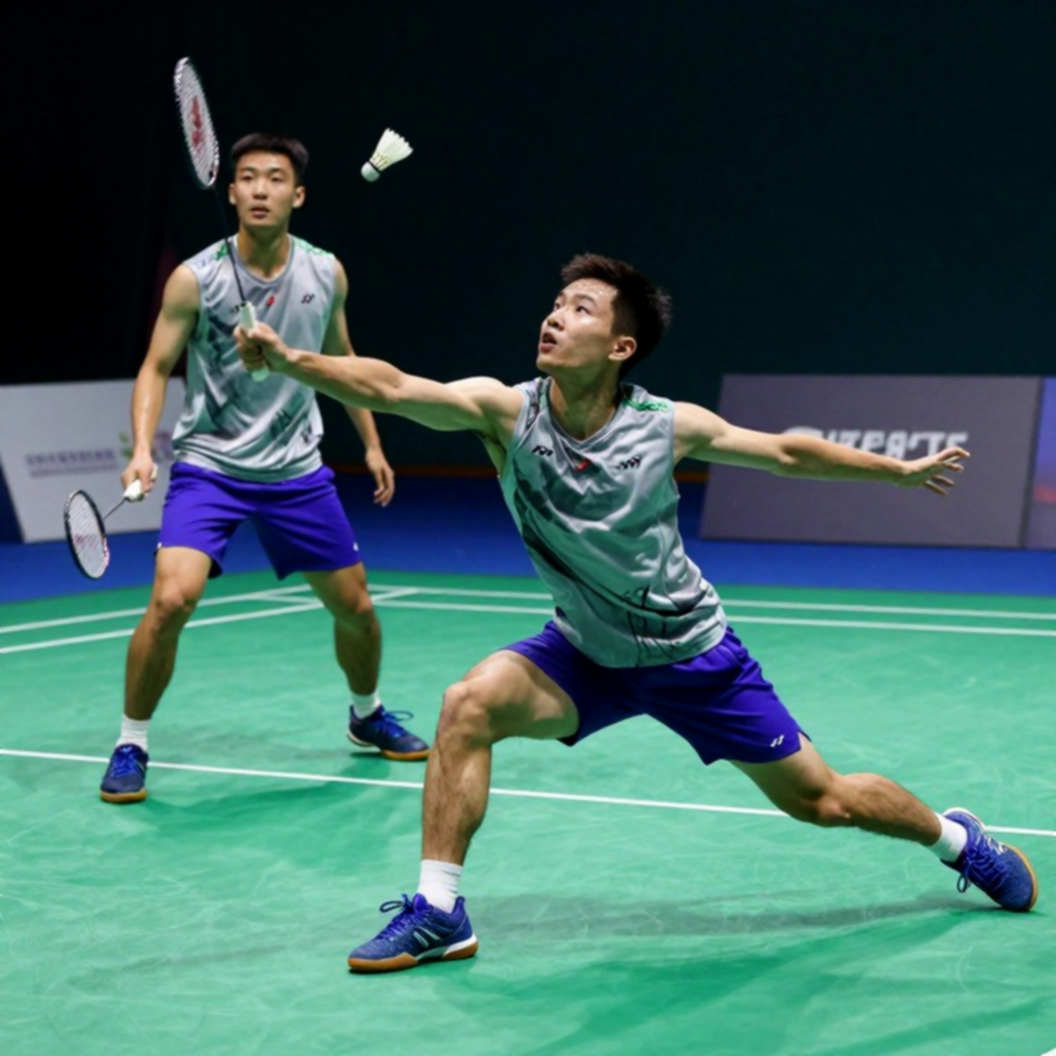
The double-digit margins in the opening games of the first two ties are not technical markers. They are markers of a level gap. When a player inside the world's elite meets a player outside the top 350, a 21-4 scoreline measures nothing about the winner's smash, nothing about movement, nothing about technique. It measures only that the two players are not competing in the same event.
Based on my own experience tracking matches, I have often had to rebuild the data of games where the scoreline said nothing. I opened the spreadsheet and realised: a scoreline only means something when you know who the opponent was. Here, we know. And because we know, we have to say plainly that this tie supplied not a single unit of tactical information — no smash speed, no rally length, no net-point win rate, no unforced error rate.
The only match with anything to read was Kidambi's. A 21-15 opening game before closing out 21-9 in the second is the familiar signature of a veteran needing a few rallies to impose rhythm against an unfamiliar opponent, then tightening up. But that is inference, not conclusion. A single rally is randomness, but a season is where probability exposes every truth — and one match is not enough to establish a trend.
Three generations in one line-up
More interesting than the scoreline is the composition of the singles line-up:
- Lakshya Sen, around 25, a Paris 2026 Olympic semi-finalist with a career-high ranking around world No. 6. He is the undisputed first singles.
- Ayush Shetty, around 21, a former BWF World Junior Championships boys' singles runner-up. He is the second singles.
- Srikanth Kidambi, around 33, a former world No. 1 in 2026 and a 2026 World Championships silver medallist. He is the third singles.
A line-up spread across three generations is data about the development pipeline, not data about form. It shows India has depth at the top, but it also shows a programme in transition rather than a settled dynasty.
The fact that India did not need either doubles match is the most valuable piece of information in the entire report. It means the leading pair — in India's current setup, Satwiksairaj Rankireddy and Chirag Shetty — enters the quarter-finals physically fresh. In exchange, they enter the quarter-finals without a single competitive rally in their legs. Freshness and match rhythm are opposing quantities, and the quarter-final is where that trade-off gets resolved.
One detail about the order of play that needs checking
The report describes the three singles ties deciding the outcome before the doubles were used. The traditional Thomas Cup format alternates: first singles, first doubles, second singles, second doubles, third singles. Under that order, both doubles matches would necessarily have been played before the third singles closed the tie. There are two possibilities: the Asian Games uses a singles-first order, or the report is imprecise. There is no basis to conclude either way, and this is a point that should be checked against the organisers' official order of play.
The venue factor
The Ichinomiya City Municipal Gymnasium is a multi-purpose hall, not a purpose-built badminton arena with the capacity of a Super 1000 final venue. Drift and lighting conditions in halls of this type can affect high clears and net play. No match played there should be assumed to reproduce World Tour arena conditions.
On the reliability of the source
The report cites no source for any of its figures: no official results portal, no match record, no statement from the organisers. For a results report, that is a problem. The official results portals of the Olympic Council of Asia and the BWF must be the authoritative record. A defining feature of an aggregated roundup — where several different sports results are bundled onto one page, for instance an Indian women's hockey result appearing alongside — is that per-item verification is typically minimal. That explains how a figure like "nine minutes" can slip through unchallenged.
The contrarian angle
The media called it an "emphatic" win. When the media calls it emphatic, I call it a probability distribution. It was an outcome predetermined by a ranking gap of more than 300 places. For a nation that won the Thomas Cup in 2026, reaching the Asian men's team quarter-finals is the minimum bar, not an achievement.
The "former world No. 1" label attached to Kidambi is a textbook case of halo-label inflation. It is factually true and analytically misleading. That ranking dates from 2026. At 33, in a sport dependent on reflex speed and lateral movement, his deployment at third singles is sensible squad management — third singles is the lowest-pressure slot in a five-match tie, usually reserved for a developing player or a protected veteran. But it is also a structural signal: India's third-singles pipeline may not yet have produced a worthy replacement.
One feature of this event is rarely mentioned: the Asian Games does not award BWF ranking points for team events. Winning here generates medals, prestige and budget arguments, but does not shift any player's position in the world rankings. That completely changes how federations calculate their objectives.
And there is one more under-appreciated risk: scheduling congestion. The team and individual events sit inside the same competition window. The three named singles players are the most likely to double up. Add the BWF World Tour's autumn Asian swing running in parallel, and the cumulative load is a genuine injury pathway, not a hypothetical one.
The industry angle
At industry level, this match generated almost no signal. There is no equipment, sponsorship, broadcast rights or prize-money data anywhere in the report. The commercial value of Asian Games badminton is concentrated in the knockout rounds and the individual events, not in a first-round tie against development-tier opposition. The only durable signal is upstream: an Indian men's team able to field three singles players across three generations is indirect evidence of a functioning development pipeline — but one tie is far too thin to model.
What to track
Three signals will determine the real value of this report:
- The quarter-final opponent. The report does not name them. If the draw puts China, Indonesia, Japan, Korea or Malaysia in India's path, the entire analytical frame shifts from "expected progression" to "structural mismatch risk".
- The use of the doubles pair. The leading pair enters the quarter-finals physically fresh but short of match rhythm. The quarter-final will answer whether that trade-off was correct.
- The individual event entry list. If Sen, Shetty and Kidambi are all entered in the individual singles draw, the load and injury risk rise materially.
Conclusion
The scoreboard from this tie confirms only one thing: India are in the quarter-finals. It does not confirm form, does not confirm tactics, does not confirm medal ambition. The quarter-final opponent — currently unnamed — is the decisive variable, and the only data worth waiting for. If the draw puts a leading Asian nation in India's path, every conclusion about "form" drawn from the Bangladesh tie will evaporate within an afternoon. Data never tells a sad story; it only points out who is lying to themselves.