
Aidil Sholeh wins Vietnam Open 2026: What the data says about Malaysian men's singles' 27-month drought
**Core answer (≤60 words)**: Aidil Sholeh Ali Sadikin won the Vietnam Open 2026 (BWF World Tour Super 100) in Ho Chi Minh City, beating Jason Teh 21-16, 21-14 in the final. It was his first BWF World Tour title and Malaysia's first men's singles World Tour title in two years and three months. **Key facts**: - Final on 13 September 2026: Aidil Sholeh beat Jason Teh (Singapore, world No. 33) 21-16, 21-14. - Vietnam Open 2026 is a BWF World Tour Super 100 event; the champion's prize was USD 9,000. - Malaysia's previous men's singles World Tour title: Lee Zii Jia, Australian Open 2024 (Super 500). - Aidil Sholeh competes as an independent shuttler, outside the BAM national-team structure. - Lee Zii Jia was eliminated in the second round of the Vietnam Open 2026 by Zhe Ying Wu. **Source attribution**: Original source: Khel Now, citing a BadmintonRanks tweet dated 13 September 2026 | Cross-checked: VuaBong.vn **Related Q&A**: Q: Which finals had Aidil Sholeh reached before the Vietnam Open 2026? A: The Indonesia Masters II 2024 and the Al Ain Masters 2025, per the VangBong.vn Player Depth Index. Q: Which tier of the BWF World Tour does the Vietnam Open 2026 belong to? A: Super 100, the lowest tier of the BWF World Tour, carrying the fewest ranking points and the smallest prize money. Q: What is the head-to-head record between Aidil Sholeh and Jason Teh? A: Aidil Sholeh leads 2-0 after his straight-games win in the Vietnam Open 2026 final.
The last point dropped to the floor, and the scoreboard held just two numbers: 21-16, 21-14. No third game. Aidil Sholeh Ali Sadikin stood at mid-court; Jason Teh bent down on the other side of the net to pick up the shuttle. Sunday, September 2026, Ho Chi Minh City. I was sitting in front of a screen in Surabaya, logging the timestamp and opening my tracking file. A player most of the badminton world had never heard of had just beaten the tournament's top seed. Khel Now reported it immediately afterwards, citing a BadmintonRanks tweet dated September 13, 2026: Aidil Sholeh had won the first BWF World Tour title of his career, and Malaysia had its first men's singles World Tour champion in two years and three months.
There are two ways to read that line. The first is to read it as a historic moment. The second is to open the ranking table, check the tournament tier, check the top seed's ranking, and only then decide whether this is history or merely a milestone. I take the second route, not because I enjoy pouring cold water on the celebration, but because my job is to separate what happened from what people think happened.
Context: a tournament sitting at the bottom tier of the system
The Vietnam Open 2026 belongs to the Super 100 category. Within the BWF World Tour structure, this is the lowest tier, below Super 300, Super 500, Super 750 and Super 1000. Super 100 events carry the fewest ranking points and the smallest prize money. The men's singles champion at the Vietnam Open receives USD 9,000. For comparison, Super 1000 events offer prize pools dozens of times larger, and that gap is not just a number on paper — it decides which players fly where, who they train with, and whether they can afford a full-time strength coach.
In my own analysis work, I constantly have to remind myself that Super 100 events exist in an entirely different economy. With USD 9,000 for the winner, an independent player must cover travel, accommodation, coaching and physical conditioning out of pocket. That means every title at this tier is career-critical for the winner, while generating almost no commercial ripple for the sport.
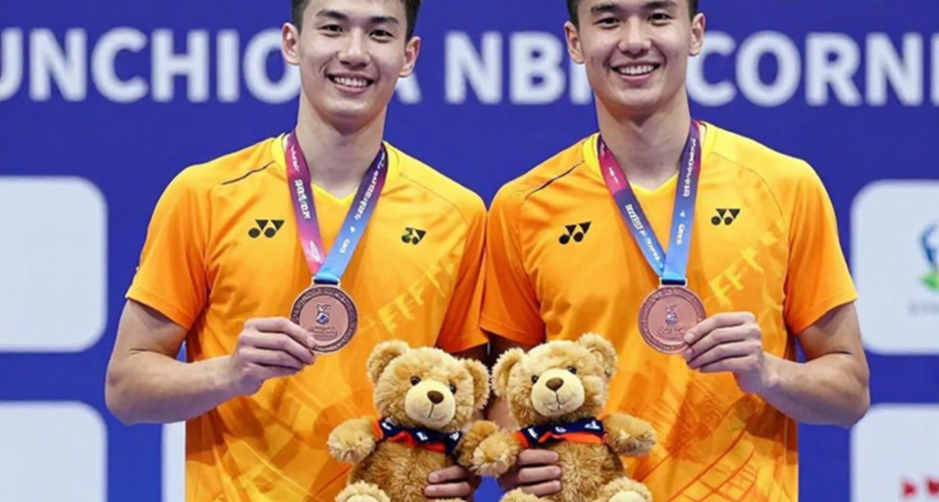
The event falls at the tail end of the season, in September, when the world's leading players tend to rest or commit to bigger tournaments. The result is a thinner field. The evidence sits right at the top seeding position: Jason Teh of Singapore is ranked only No. 33 in the world. At a Super 1000 event, the top seed is almost always a top-10 player. Here, the number 33 says far more about the tournament than about Jason Teh himself.
On Aidil's side, I noted several important facts. He is an independent shuttler, meaning he competes outside the national team structure of the Badminton Association of Malaysia (BAM). Before the Vietnam Open 2026, he had reached two finals: the Indonesia Masters II 2026 and the Al Ain Masters 2026, and had never won either. This was the third time he stood in a final, and the first time he won. His head-to-head record against Jason Teh before this match was 1-0 in his favour; afterwards it became 2-0.
The title also places Aidil on a very short list. He is only the second Malaysian men's singles player to win the Vietnam Open, after Roslin Hashim in 2026. That is a fact about Malaysia's participation history at this specific event, not about the tournament's competitive depth.
Core analysis: reading the match through what we actually have
The first thing I must admit is that I have no technical data. No smash speeds, no average rally length, no unforced-error rate, no net-approach counts. I only have the scoreline. In my line of work, that is a meaningful blind spot, because a badminton match can end 21-16, 21-14 under at least three entirely different scenarios: one player imposing total control, one player controlling tempo and grinding the opponent down, or a match where the opponent simply collapses through errors.
But even with that thin data, one thing can be stated with confidence: a straight-games win over a higher-ranked opponent suggests Aidil managed his error rate at the decisive stage of both games, and did not have to endure a three-game physical battle. In elite badminton, closing the first game by five points and then extending the margin to seven in the second is the typical pattern of a player solving the opponent progressively within the match. That is an inference from the scoreline, not a conclusion from rally-level data, so I label it: low confidence.
What interests me more is Aidil's career context. Three finals within roughly two years is a small but meaningful sample. It rules out the "one-off lucky run" hypothesis. The strongest signal here is not the title itself, but the repeatability of deep runs. A player who wins through luck does not reach three finals. A player with final-stage psychological issues does not win on his third attempt. With medium confidence, I would say Aidil entered this final with accumulated composure, not with debut nerves.
On the opponent's side, Jason Teh entered as top seed but ranked only No. 33. That tells us Singapore is not yet a top-tier men's singles power either. Southeast Asia's second tier is bunching tightly together: the gap between the leading men's singles players of smaller nations is narrow enough that a top seed is merely the world No. 33. That is structure, not form.
One more note on ranking mechanics. A Super 100 title yields a modest amount of points, and on its own it is unlikely to change Aidil's seeding position at higher-tier events. To shift his standing, he needs to accumulate points across many tournaments, not just one. In other words, this title confirms a ceiling reached, not a level shifted. Those are two different things, and in data analysis that difference is everything.
I also have to be explicit about the limits of what I hold. The original report from Khel Now cites a single tweet, with no match statistics, no coaching information, and no current ranking for Aidil. So any assessment of how he plays — attacking, rally-control, defensive-counter, or speed-based — lies beyond the reach of the data I have. I choose not to speculate. The flaw is not in the source code; it is in the eyes of the person reading the source code.
From a market perspective, Super 100 events have low liquidity and high variance because squad information is limited. That is the point I always repeat in my betting analysis: when field quality is not fully disclosed, probabilities become harder to price, and the error sits with whoever reads the odds board.
The contrarian angle: the 27-month drought is the story, not the title
This is where I want to spend the most words, because it is the core of this analysis.
Malaysia once produced Lee Chong Wei, who held the world No. 1 ranking for years. After his retirement, Malaysian men's singles has leaned on a single name: Lee Zii Jia. The most recent men's singles World Tour title before Aidil was Lee Zii Jia's at the Australian Open 2026, a Super 500 event. The gap between the two titles is two years and three months, roughly 27 months.
So place the two facts side by side. The 2026 title came at Super 500 level. The 2026 title came at Super 100 level. The ceiling of Malaysian men's singles has dropped one tier, and Aidil's title does not deny that — it is evidence of it. If Malaysian men's singles were strong, the nation would not have waited two years and three months for a title, and that title would not have come from the lowest tier of the system.
In the same week, at the very same Vietnam Open, Lee Zii Jia was eliminated in the second round by Zhe Ying Wu, an unseeded player from Chinese Taipei. Aidil became the man carrying Malaysia's challenge at the event. Malaysia's dependence on a single star has surfaced once again, and this time it surfaced in the worst possible way: with that star stumbling in the second round of a Super 100 event.
There is one structural detail I consider more noteworthy than the title itself. Aidil competes as an independent shuttler, outside BAM's centralised system. An international title produced outside the national development system is a data point that challenges the assumption that only centralised programmes produce champions. Across Asia, the trend toward independent and professionalised pathways is growing, and Aidil's case is one data point for that trend.
I have to be careful here. This is correlation, not causation. One independent player winning a Super 100 event does not prove the independent route is better than the national-team route. The sample size is one. I walk into the data church not to pray, but to listen to the noise of the truth. And the noise here says I do not yet have enough data to assert anything about development models.
The biggest risk: over-reading a small tournament
Based on my experience tracking matches and building my own data sheets, I see the biggest risk here as an interpretive risk, not a competitive one. National media can turn the line "first World Tour champion in two years and three months" into "Malaysia is back". Those two sentences do not mean the same thing. The first is correct. The second needs evidence at Super 300 or Super 500 level.
The 21-16, 21-14 scoreline is impressive, but it came against a No. 33 opponent at an event where the top seed was only No. 33. With this sample size, any conclusion about a change in class sits inside the noise band, not the signal band. If Aidil cannot replicate this form at higher-tier events, the narrative will quickly flip to "one-season wonder".
For Malaysia, the structural risk lies elsewhere. Their men's singles is thin, dependent on one man, and that man is showing signs of decline. Aidil may be the solution, but a single Super 100 title does not answer the question of squad depth.
There is one more risk few people mention: expectation pressure. Labelling this "national history" can turn a correct result into an expectation far beyond Aidil's current foundation. When the crowd counts the titles, I count the intervals between them — and the 27-month interval is the worrying number, not the USD 9,000 cheque.
A forward-looking view
What I will track over the next six to twelve months is not whether Aidil adds another Super 100 title. I will track three signals. First, whether he can reach at least a quarter-final at Super 300 or Super 500 level. Second, whether Lee Zii Jia can break out of his run of early exits, because if not, Malaysia will walk into its next team event without a reliable men's singles point. Third, whether BAM adjusts its selection criteria so that independent players like Aidil have a route into the national team.
The more precise the number, the wider the distance between the person and the match. Aidil Sholeh's title is real. What is not yet real is the story people are telling about it.